
24 April 2016 NA LostCousins Newsletter

Newsletter - April 24, 2016
North American edition
We'll be 12 years old next Sunday!
What it's all about - Mary's story
Let's celebrate with 33% off at Findmypast EXCLUSIVE - ENDS SATURDAY
....and get a FREE LostCousins upgrade
Donald Trump and Hillary Clinton are related!
Ireland 1916: Easter Rising records go online FREE UNTIL APRIL 27
Why autosomal DNA tests are so powerful
Time to take a DNA test? ENDS TUESDAY
Family Historian v6 adds record matching at Findmypast
Competition: win a signed copy of Steve Robinson's latest book
Ancestry reports increased profits
Get a sneaky peek at Ancestry's records
Humans and Neanderthals - the Y and the wherefore
The North American edition of the LostCousins newsletter is published occasionally. There's also a UK & Worldwide edition which is published 2 or 3 times a month - to switch to this edition change the preferences on your My Details page.
Whenever possible links are included to the websites or articles mentioned in the newsletter (they are highlighted in blue or purple and underlined, so you can't miss them). If one of the links doesn't work this normally indicates that you're using adblocking software - you need to make the LostCousins site an exception (or else use a different browser, such as Chrome).
To go to the main LostCousins website click the logo at the top of this newsletter. If you're not already a member, do join - it's FREE, and you'll get an email to alert you whenever there's a new edition of this newsletter available!
We'll be 12 years old next Sunday!
Sunday May 1 will be the 12th anniversary of the day in 2004 that the LostCousins website went live - and it will be our first birthday since passing the 100,000 member mark last September.
Whilst I know that this newsletter is extremely popular amongst family historians, we mustn't forget that the main reason LostCousins exists is to connect cousins across the globe - so it was appropriate that Mary wrote to me this week from South Africa.....
What it's all about - Mary's story
Mary is a fairly new member - she joined last September - but she didn't have very long to wait for her first success. Here's an extract from the email she sent me on Tuesday:
"First of all I would like to say how much I enjoy reading your newsletters, secondly I have been meaning for some time to write to you to let you know how well Cousin Patricia and I have been getting along; apart from being able to share our family information and current research we have become friends, it is as if we have always known each other.
"We have been able to add another cousin to our research. I remembered a family I met when I was a child, they had a son a few years younger than I, and Patricia was able to find him. He in turn belongs to the North West Kent Family History Society, and has done so for many years. As Patricia says, we have become a very good team...
"Thank you Peter for all the enjoyment we are experiencing!"
One-third of all the matches at LostCousins involve members who live on different continents, something that I find amazing in so many ways. Even a generation ago there would have been little chance of making connections like these - Mary in South Africa, and Patricia in England - but now, thanks to the Internet, we can bring together families that have been separated for generations, if not centuries!
Let's celebrate with 33% off at Findmypast EXCLUSIVE - ENDS SATURDAY
Findmypast are sponsoring the pre-birthday party. Until the end of April you can join in the celebrations when you buy a new 12 month World subscription and take advantage of an extremely generous discount offer that is absolutely exclusive to LostCousins members.
There was a unique discount code in the email that alerted you to this newsletter - simply click the link below and enter your discount code to save an amazing 33% on a World subscription (that's a saving of nearly $80!):
All World subscriptions are the same, whichever site you subscribe through, and once you have your subscription you can use it at any of the sites. However, your unique discount code will only work at the site specified in the email you received (this was chosen based on your address in my records).
You can't do better than a 12 month World subscription - it offers unlimited access to ALL of Findmypast's 8 billion worldwide records and newspaper articles, including a massive US marriage collection which is still growing, censuses, vital records, military records, an amazing collection of Irish records, British and Australian records.... the list goes on and on.
You can see a list of all the record sets if you click the Search tab at the Findmypast site, choose A-Z of record sets from the drop-down menu, then click Show list of everything.
....and get a FREE LostCousins upgrade
When you purchase a NEW Findmypast 12 month subscription using the links above you'll be supporting LostCousins. So I'm going to return the favour by giving you a free 12 month subscription to LostCousins this will run from the date of your purchase unless you’re already a LostCousins subscriber, in which case I'll extend the expiry date by 12 months.
Simply forward a copy of your email receipt from Findmypast, making sure that it shows the precise time and date (and the timezone). I recommend you also make a note of the precise time you conclude your purchase just in case the receipt doesn't arrive - sadly some email providers are less than reliable (and I'm talking about some of the biggest names). I don't publish my email address online, but you can use any of the LostCousins addresses, including the one in the email that told you about this newsletter - all emails come to me.
IMPORTANT: your LostCousins subscription will be paid for by the commission we receive from Findmypast, which means that you must use the appropriate link in the previous article (and it must be the last link you click before you make your purchase). Unfortunately using the special discount code isn't sufficient. If you've configured your browser to prevent tracking, or if you use two different devices (or two browsers) during the process, then sadly your purchase won't be credited to LostCousins, and you won't get your free subscription.
Donald Trump and Hillary Clinton are related!
A genealogist in Illinois claimed last month that Donald Trump is related every one of the 43 Presidents of the United States, including Abraham Lincoln and Bill Clinton (see this news article for more details). Since the most distant connection (to Franklin Roosevelt, not Barack Obama as you may have suspected) involves a number of marriages it's clear that Donald Trump must be at least as closely related to Hillary Clinton as he is to FDR.
Even if the research is correct it's only telling us what we already know - because ultimately we're ALL related!
Note: while researching this article I found some other, earlier, research which was published in the Washington Times last August - you can read it here.
Ireland 1916: Easter Rising records go online FREE UNTIL APRIL 27
It's almost 100 years exactly since the Easter Rising in Dublin which led eventually to the founding of the Irish Free State.
 The
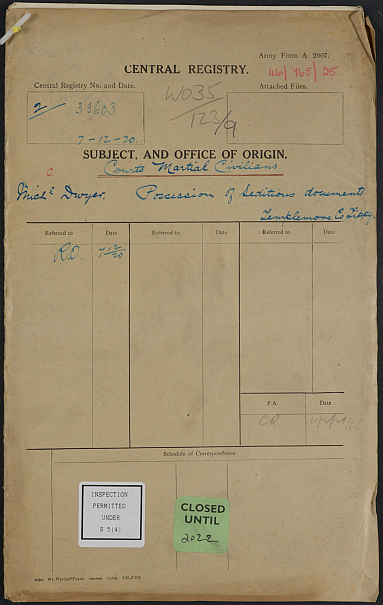
National Archives in London, England have 75,000 documents from this period,
many of which were originally intended to be kept secret until 2022 - see the image
on the right (which is Crown Copyright, and reproduced by courtesy of The
National Archives and Findmypast).
The
National Archives in London, England have 75,000 documents from this period,
many of which were originally intended to be kept secret until 2022 - see the image
on the right (which is Crown Copyright, and reproduced by courtesy of The
National Archives and Findmypast).
Until April 27 these records will be accessible completely free of charge at Findmypast - you will need to register, if you haven't already, but you won't need to provide credit card information or bank details.
You can access the records using the following link: Findmypast.com
After that date they will be included in the Ireland, Britain, and World subscriptions.
According to the Findmypast press release:
"More than 3,000 people were injured or killed in a conflict which saw three civilians killed for every one rebel. The records reveal the impact that the conflict had on men, women and children across Ireland. There are eye-witness accounts, interviews with civilians and reports of the trials of the leaders of the Rising and their sentences of execution.
"The once classified records shine new light on the subsequent period of Martial Law in Ireland which was declared by the Lord Lieutenant in 1916, including the War of Independence, when the British military assumed control of the executive, judiciary and legislative arms of the entire country.. The contents of the collection provide a picture of what life was like for ordinary citizens in Ireland during this turbulent time.
"The 25,000 search and raid records show the efforts of the military and police to discover arms, ammunition and seditious material through thousands of raids as well as their search for individuals associated with Sinn Féin, Irish Citizen Army, Irish Volunteers and the Irish Republican Army. Members of the public accessing the records on Findmypast will find the names of the thousands of people who were detained and interned in prisons in Ireland, England and Wales and tried by courts martial, including the names of prominent nationalists and elected officials.
"Military correspondence between the barracks in Dublin and the War Office in London grants new perspectives on the motivations and fears of the British Army leadership. The movements and actions of several key nationalist figures are also documented, including those of James Connolly, Eamon De Valera, Thomas Ashe, Joseph MacDonagh, Arthur Griffith, Padraig Pearse and Francis and Hannah Sheehy Skeffington and Countess Markievicz."
There are many perspectives on Irish history - these secret records will no doubt prove both informative and controversial.
Why autosomal DNA tests are so powerful
This week there has been a ongoing discussion over at the LostCousins Forum which has made it clear that almost all of us have 'brick walls' in the last 5 generations (ie going back as far as our 32 great-great-great grandparents).
Fairly recent 'brick walls' like these can be the most frustrating, because they bar access to such a large part of our ancestry - for example, I cannot find the birth or baptism of one of my great-great grandmothers. This means that one-sixteenth of my tree is effectively out of bounds - that fact that on her husband's line I'm back to someone who died in 1605 just rubs salt in the wound!
Fortunately this is the part of our tree that's within the range of autosomal DNA tests, the newest and in many ways the most powerful tests, because they look at hundreds of thousands of sites on our genome (earlier tests looked at a small number of markers - sometimes as few as 12 or even 4). Equally importantly, they're looking at the DNA we inherit from both our father and our mother (who in turn got from their parents, who got it from their parents, and so on.....).
On average we have inherited about 3% of our DNA from each of our great-great-great grandparents. It doesn't sound like a lot until you consider that there are over 3 billion base pairs in our DNA - so that 3% is actually an awful lot of base pairs. Of course, most of us can't afford to test our entire genome, but a typical autosomal test looks at around 600,000 sites, which means that 3% is still a pretty big number.
Cutting a long story short, an autosomal test can produce matches on any of our family lines from the last 5 generations - although, because of the way that DNA is inherited it might be possible to go back a bit further on some lines than others (as in the example I describe below). Armed with this information you would probably expect to get about 32 times as many matches as from a test that only looks at one line, such as Y-DNA test.
Actually it's a lot better than that - because the people we're being matched against are also getting matches on 32 lines. So in theory you might get 1000 times (32 by 32) as many matches - it's no wonder Family Tree DNA call their autosomal test Family Finder!
In practice the testing companies don't tell us about all of our matches, only the closest matches - for example, I've got just over 720 matches at the moment. Inevitably there are many more distant matches than close matches, simply because we have many more distant cousins than we do close cousins, and it usually makes sense to start by looking at the closest matches.
Lots of matches sounds like a good thing - and it is - but actually pinning down how we are related to each of our matches is quite a challenge, especially if you're the only person in your extended family who has tested. So I've done what many other family historians have done, and persuaded some of my distant cousins to test as well.
There are two key benefits from this approach - first of all, the fact that my DNA matches my cousin's DNA validates our research to date as far back as our common ancestors. After all, as the recent example of the Archbishop of Canterbury demonstrates, the paperwork isn't always right.
This week I found a DNA match with someone who shares my great-great-great grandfather (born in 1794) - but is descended from his first wife, whereas I'm descended from his second wife. Discovering that my new half 4th cousin once removed shares my DNA proves that we've both done our research correctly, even though it stretches back 222 years and 5 or 6 generations.
The second advantage - and this is the big one - is that when my cousin and I both test our matches are going to overlap, and where they do overlap we can be fairly certain that those matches are on the lines that we share. This makes it much easier to work out how we're related to our 'new' cousins.
Although it has been around for 30 years, DNA testing is still in its early days - even now only a small percentage of researchers have tested their DNA. Nevertheless there are well over 2 million who have taken autosomal tests, and the numbers are growing rapidly, the potential for finding DNA cousins is enormous.
DNA testing isn't a substitute for good old-fashioned paper research, but it complements it extremely well. Paperwork can be lost or falsified, but DNA can't be faked - it's like a watermark that runs through the generations.
Tip: the reason why testing companies only tell us about the closest matches is because the less DNA we share with another person, the more likely it is that it matches purely by chance. However, if you want to investigate further, you can upload your results to the free GEDmatch website and adjust the parameters yourself. Incidentally using GEDmatch has another big advantage - it allows you to match your results against those of people who have tested with different companies (which is why price is the most important factor when deciding who to test with).
Time to take a DNA test? ENDS TUESDAY
Until Tuesday 26th April there are big savings to be made on DNA tests from Family Tree DNA, the ONLY big company to provide ALL of the different tests that genealogists are most likely to need.
However for most researchers an autosomal test is the best option, for the reasons I've explained in the previous article - and, perhaps surprisingly, autosomal tests are also the cheapest meaningful tests. Family Tree DNA's regular price is $99, but during the sale you'll pay just $79.
This is a significant amount of money, but it's about half what you'd pay for a Y-DNA test (which only looks at your direct paternal line) - and you're guaranteed to get lots of matches, whereas a Y-DNA test might produce none at all, as I know to my cost. As for mtDNA tests - well, don't get me started.....
What does a DNA test involve? Either you'll provide a sample of your saliva, or a scraping from the inside of your cheek - depending on the instructions that come with the kit - so it's not complicated or painful. DNA tests from Ancestry DNA and Family Tree DNA don't provide any health-related information, so there's no possibility that your health insurance costs will go up (or down) as a result of testing.
Family Historian v6 adds record matching at Findmypast
The family tree program I aspire to use for my own research is Family Historian, which has been on my computer since version 2 (it's now up to version 6.2).
Whilst I'm still using the program I started with in 2002 as my main program, every now and again I export a GEDCOM file then import it into Family Historian - and so I was very excited to hear that Family Historian will now automatically match against records at Findmypast.
I've been very impressed so far with this new feature, and whilst you obviously need a Findmypast subscription to look at the records themselves, this is going to be a great timesaver for many people.
Note: I'm about to start reading Getting the Most from Family Historian 6, by Simon Orde, the developer of Family Historian - it has only just been launched, and sold out at the recent show. I'll be reviewing it in a future newsletter - but don't expect to see the review any time soon, because the book is absolutely crammed full of information about features that I didn't even know existed!
This thin (31 page) book by Lynn Assimacopoulos describes her true-life search for the birth parents of Ryan, a friend of her son, who had lost both his adoptive parents in a car crash. It's well written but, perhaps because I could read it in less than hour, it didn't entrance me in the way that The Daddy of All Mysteries, the true story of Jess Welsby's search for the father she never knew, did.
Not knowing anything about the adoption system in the US, it was also difficult for me to gauge how challenging the search was, or what the chances of success were at the outset - but I suspect that family historians who live in America will possess more insight into the obstacles that confronted the author.
Separated Lives is available from Amazon.com
 Steve Robinson's
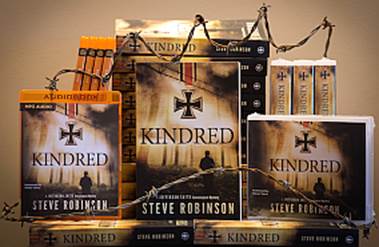
latest book is a cracker! I was privileged to receive a review copy ahead of publication,
and once I started reading it, I found I couldn't put it down.
Steve Robinson's
latest book is a cracker! I was privileged to receive a review copy ahead of publication,
and once I started reading it, I found I couldn't put it down.
I'm sure that most of you reading this article will be familiar with Jefferson Tayte, the food-loving professional genealogist who is the hero of Steve Robinson's mysteries - but where the latest book differs is that Tayte is at last able to turn his attention to his own family tree. Adopted as a baby, his only clue to his parentage is a photograph of a woman who he believes to be his mother - and she's standing in front of a building in Munich, Germany.
There are two threads to the story - in one we follow JT and his colleague Professor Jean Summer as they follow leads in the present day; in the other we learn about two German adolescents who become bosom pals after joining the Hitler Youth in the 1930s, but whose friendship is strained when they both fall for the same Fraulein. Only at the end do we learn whether or not the two threads are intertwined and, if so, how - and I'm certainly not going to spoil your enjoyment by giving you any more clues!
Kindred is available as a paperback, as a Kindle e-book, and as an audio download. I read the book on my iPad, but there are free Kindle readers available for most devices - usually I read books on my smartphone (and would have done so on this occasion had I not smashed the screen).
If you do decide to order Kindred (or anything else that Amazon sell), you can support my work by using one of the links below:
Competition: win a signed copy of Steve Robinson's latest book
The reviews for Kindred are amazing, with reviewers at Amazon.com giving it an average rating of 4.6 out 5.
Most of you probably buy Kindle books, I'm sure - but wouldn't you love to have a paperback copy signed by Steve Robinson himself? I know I would, but sadly I'm not allowed to enter the competition.
All you need to do to enter the competition is send me an email which lists Steve's five Jefferson Tayte novels in order of publication, and tell me (in no more than 40 words) which is your favourite and why. You don't need to have read them all - though how anybody could read one and not read them all beats me!
The member I judge to have sent in the best answer will win the prize (though I may ask for Steve Robinson's help with the judging). You can use any of the LostCousins email addresses, but please use 'Competition entry' as the subject so that I can file it away until Judgement Day.
The closing date of the competition is Friday 6th May (which would have been my father's 100th birthday); entries received after that date may be read, but won't be considered for the prize.
My father didn't have a Facebook page when he was alive, but he acquired one after he died in 2011. Apparently there are millions of Facebook users who are now deceased, and it's possible that at some point in the future there will be more deceased users than living ones - according to this BBC Future article which was spotted by LostCousins member Elaine.
Often users live on digitally for the simple reason that their log-in details died with them - even today few websites allow users to nominate a beneficiary, as LostCousins has since 2004.

Mind you, very few LostCousins members have taken advantage of this feature - though whether that's because they think they're going to live forever or because they're not aware of it, I'm not sure. Perhaps you'll log-in and update your My Details page now that you know the option exists? I certainly hope so.
Ancestry reports increased profits
You may have read recently that Ancestry has been taken over (again) although it's difficult to find out exactly how much of the company is owned by which investors.
But whoever owns Ancestry, their investment seems to be flourishing - the number of subscribers increased by 5% in the first three months of 2016, and sales were up by over 20% compared with the same period of 2015.
People keep saying to me that interest in family history seems to be declining but if Ancestry - the market leader - is growing, then the number of serious researchers is clearly continuing to rise. Perhaps the reality is that there are fewer people with a casual interest, but more like you and me? If so, that can only be a good thing!
Note: you can read Ancestry's detailed announcement on their corporate website here.
Get a sneaky peek at Ancestry's records
Unlike Findmypast, Ancestry doesn't usually give out very much information with their free census searches - you normally have to be a subscriber to find out very much.
But an eagle-eyed member (who has asked not to be named in case of reprisals) pointed out to me that if you allow the mouse pointer to hover over the View record link the transcription appears in a pop-up window, as you can see from this screenshot:
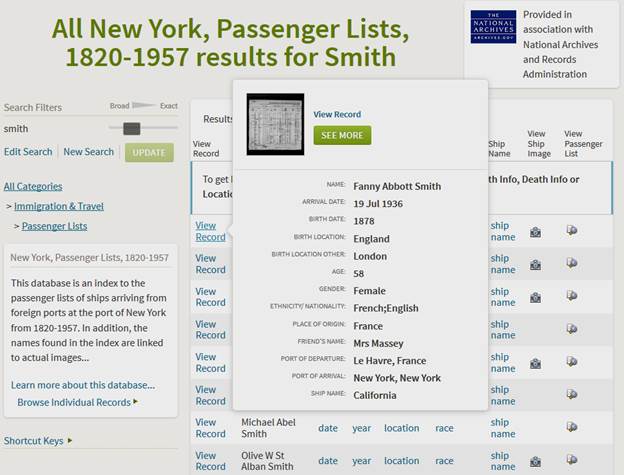
I don't know how long this anomaly will last, but why not make the most of it while you can?
Humans and Neanderthals - the Y and the wherefore
A few weeks ago New Scientist had an article which briefly reported some interesting research which showed that although most humans have inherited some Neanderthal DNA (typically 1%-4%) there are no remnants of the Neanderthal Y-chromosome in modern human males (you can also read about the research in this BBC article).
The scientists came up with some complicated theories why this might be the case, but I look at this more simplistically - perhaps human woman simply didn't fancy Neanderthal men?
This is where any last minute updates and corrections will be highlighted - if you think you've spotted an error (sadly I'm not infallible), reload the newsletter (press Ctrl-F5) then check here before writing to me, in case someone else has beaten you to it......
That's all for this issue - I'll be back soon with more news from the wonderful world of family history..

Peter Calver
Founder, LostCousins
© Copyright 2016 Peter Calver
Please do not copy any part of this newsletter without permission. However, you MAY link to this newsletter or email a link to your friends and relatives without asking for permission in advance - though why not invite them to join LostCousins instead as standard membership, which includes this newsletter, is FREE?