
Newsletter
- 10th January 2015
Nottinghamshire
transcriptions go online
ScotlandsPeople
add more BMDs
New
Year Competition extended WIN UP TO £150 IN CASH!!
MASTERCLASS:
Tracking down pre-1837 baptisms and marriages
How
to be accurate - and why it matters!
Using
Family Tree Analyzer to spot errors
Checking
your My Ancestors entries
Online will
service still isn't working perfectly
Frustrated
with Findmypast?
Reading
between the lines
Rags
to riches - how a laundry maid became a Viscountess!
Mystery
artist identified
Birthday
Book puzzle solved?
Review:
A Suitable Young Man
Genealogy in the
Sunshine - more places released
Stop
Press
The LostCousins
newsletter is usually published fortnightly. To access the previous newsletter (dated
25th December) click here, for an index to articles from 2009-10
click here, for a list of articles from 2011
click here and for a list of articles from
2012-13 click here. Or use a Google search prefixed by 'site:lostcousins.com' - that's what I do!
Whenever possible links are included to the
websites or articles mentioned in the newsletter (they are highlighted in blue or purple and underlined, so you can't miss them). If one of
the links doesn't work this normally indicates that you're using adblocking software - you need to make the LostCousins site an exception (or else use a different
browser, such as Chrome).
To go to the main LostCousins
website click the logo at the top of this newsletter. If you're not already a
member, do join - it's FREE, and you'll get an email to alert you whenever
there's a new edition of this newsletter available!
Nottinghamshire
transcriptions go online
This week Findmypast have made available
online over 1.75 million parish records for Nottinghamshire which have been
transcribed by members of the Nottinghamshire Family History Society. You can
find out more here.
ScotlandsPeople
add more BMDs
On 1st January each year ScotlandsPeople
add an extra year of birth, marriage and death registers to their online
collection. This year the additions are 1914 births, 1939 marriages, and 1964
deaths.
What a shame we aren't allowed to see
the equivalent registers for England & Wales - those Scrooges at the GRO in
Southport are still insistent on sticking with the paper-based system devised
before Queen Victoria came to the throne.
Their attitude seems to be "If it
was good enough for King William IV it should be good enough for you"!
All I can say is "Bah, humbug"
(to quote Charles Dickens)!
New Year Competition
extended WIN UP TO £150 IN CASH!!
As so many members didn't receive my
Christmas newsletter until this week (because it went to their office email
address) the closing date for the New Year Competition has been extended - the
winners will now be chosen on Tuesday 3rd February.
The competition is open to ALL LostCousins members who joined before midnight on Christmas
Eve - you don't need to be a subscriber, or to be taking part in the LostCousins project.
To have a chance of winning the First
Prize of a One-Year Subscription to Deceased Online, the only website
specialising in records from local councils, AND up to £150 in
cash simply use your My Referrals
page (or your personal referral link, which you'll find on your My Summary page) to invite a fellow
family historian - whether a friend or relative - to join LostCousins.
There are also 10 Runners-Up prizes -
each will get a FREE one-year LostCousins
subscription worth up to £12.50, AND a FREE digital photo
repair/restoration worth up to £8.99 donated by Repixl
, who have already
produced stunning results for hundreds of LostCousins
members.
Here
are some suggestions for people to invite:
There's
another set of prizes for the new members you sign up - the First Prize is up
to £150 in cash, and there are also 10 Runners-Up prizes (as above). Please see
this article in my last newsletter for full
details of the competition.
Tip:
if you received this email at your work address please
consider using your personal email address instead - so many of the best
offers are at weekends or holiday times.
MASTERCLASS: Tracking down pre-1837 baptisms and
marriage
Researching
ancestors who lived in England & Wales is usually fairly straightforward
until we get back to 1841, the date of the first census, and 1837, the year
that civil registration began. But then it becomes much tougher, for a number
of inter-related reasons. In this masterclass I'm going to first talk
through the problems, and then explain how you can overcome them.
Why
we need to use different techniques
When
we're researching after 1837 we can refer to the GRO indexes, which (in theory
at least) list everyone who was born, or married, or died in England &
Wales. Once we get to 1841 we can refer to censuses which (again, in theory)
list everyone in the country on a certain night. Best of all, those indexes and
censuses are available online, so anybody anywhere can get access to them.
But
before 1837 we don't have either of those available to us - prior to the
introduction of civil registration parish registers are by far the best sources
of early information (and often the only surviving documents that name our ancestors).
Most people were baptised, most of those who have descendants alive today got
married, and the one thing you can be sure of is that they eventually died, in
which case they'll almost certainly have been buried somewhere.
However,
even though the vast majority of baptism, marriage, and burial registers have
survived, the registers are scattered across the nation. In most cases the
original registers are held by the county record office, which means you cannot
go to any one record office - not even the National Archives - and expect to
find all the baptisms for (say) 1797. Indeed, even if you visit the repository
of the registers you're seeking the chances are you'll only be able to view
them on microfilm.
Many
registers have been transcribed, often by volunteers, and in some cases the
transcriptions have been made available online. However you can't just go to
one website and search through every parish register that has ever been transcribed,
because some transcriptions are available at one site, some at another - and
even if you have the time to visit them all, many of the transcriptions are
only available at subscription sites, so you may not be able to access them.
Furthermore, some of the transcriptions are only available on CD ROM or on
microfiche - usually through family history societies - and many registers have
NEVER been transcribed
Faced
with such a different situation some researchers just give up - research
pre-1837 is so different that they are scared to even try. Some try, but fail -
either because they don't fully understand how best to make use of the
available resources, or because they don't realise just how much is available
to them.
Because
of the way that records are scattered across the country, across the Internet,
and across different media, it's tempting to adopt an unfocused "where
shall I try next" approach. Now, I'm not a professional genealogist, but
one thing I do know is that professional genealogists always search logically
and methodically, and above all they record where they have
searched and what they have searched for. I can't count the number
of times members have written to me saying they've searched everywhere for a
certain baptism, yet when pressed they can't tell me which parishes they've
searched, which periods the searches covered, or even - in some cases -
precisely what surnames and spellings they looked for.
Start
by gathering the evidence
First
collect all the evidence that indicates - no matter how obliquely - where and
when your ancestor is likely to have been born. Sources of information will
often include early censuses, marriage certificates, and death certificates -
all of which can be helpful, but can also be misleading.
Many
people didn't know where they were born, so often the birthplace they gave when
the enumerator came round is the place - or one of the places - where they grew
up. Some people didn't know how old they were - they might have known when they
were born, but that isn't the question on the census form. It asks for their
age, and not everyone was capable of subtracting one year from another,
particularly if the years were in different centuries.
Remember
too, that it was the householder who was responsible for completing the form
(or supplying the information to the enumerator) - the ages and birthplaces of
adopted children, stepchildren, servants and visitors are particularly unlikely
to be correct.
Search
the IGI
Your
next step will often be to search the International Genealogical Index at
FamilySearch; the IGI probably has more parish register entries than any other
website, and yet it's free! Now and again I'm lucky enough to find someone who
looks as if they may be my ancestor, and has a sufficiently
rare name that there are unlikely to have been two of them around in the same
place at the same time. However, not many names are that rare - indeed, many of
the surnames we now think of as rare were once quite common in certain parts of
the country.
Tip:
some researchers assumed that the IGI disappeared along with the old
FamilySearch website. It's true that there was a time when the IGI was not
available at the new FamilySearch site, but you can now find it here.
There
are two types of entries in the IGI - those that are described as Community
Indexed and those that are Community Contributed. The
former are extremely reliable, but the latter are very variable - for example,
there are many entries which are clearly not taken from parish registers and
are often simply conjecture. It's perhaps just as well that the two sets can
only be searched separately!
If
you don't find the entry you're seeking in the IGI it's usually because the
register that contains the entry hasn't been transcribed and included in the
index. Although FamilySearch has at some point microfilmed most of the
surviving parish registers, only about half have been transcribed and indexed -
so half the baptisms and marriages you're looking won't be in the database at
all.
Tip:
hardly any burials for England & Wales are included in the IGI.
How
can you find out which registers are included? The simplest
way is to refer to Steve Archer's site (which covers Scotland and Ireland as
well as England & Wales). As well as listing the years of coverage by
parish and by event the site also gives the relevant batch numbers - searching
by batch number is not only a great way to limit your search to a specific
parish, it's a great way to overcome transcription errors or entries that have
been recorded incorrectly by the clergyman who conducted the service (when you
omit the person's name you'll get a listing of all the entries in the batch).
What
should you do if the parish you're interested in is included in the IGI, but
you still can't find the entry you're looking for despite searching through the
relevant batch (in case there has been a major transcription error)? This
suggests that the event didn't take place where you think it did, or when you
think it did - or didn't take place at all (not all children were baptised).
Find
out which other parishes are nearby
There
are at least two ways to do this. One is to use a 'parish locator' (such as the
free ParLoc program) to get a list of
all the parishes around the town or village where you believe your ancestor to
have been born or married. In the country you might use a 5 mile radius, but in
London that could give you a list of 100 or more parishes - so a radius of 1 or
2 miles might be more appropriate.
Tip:
the nearest parish church may have been in a different parish - the size and
shape of parishes varies enormously.
The
fact that I haven't been able to find the baptism or marriage in the IGI
strongly suggests that it's recorded in a register that isn't included in that
index, so I go back to Steve Archer's invaluable website to find out which
parishes aren't included in the IGI for the relevant period - and they’re the
ones that I focus my attention on.
However
my preferred solution is to use the maps at FamilySearch - these are wonderful but
only cover England & Wales.
At
the old FamilySearch site you were limited to the IGI, which hadn't been added
to for many years - but the new FamilySearch site has a wealth of other
records. For example, there are 69 million baptisms in the dataset described
as England, Births and Christenings, 1538-1975, and 16 million
marriages under England, Marriages,1538-1973.
Many of these entries are also found in the IGI, but some are different. I
believe these records sets are based on the Vital Record Index which was
previously distributed on CD ROM.
Tip:
those records can also be searched at Findmypast.
FamilySearch has indexed
transcriptions, but not images, for Cheshire, Plymouth & West Devon,
Yorkshire, and Wales, and many images, mostly indexed, for Norfolk. FamilySearch also has parish
register images for part of Kent, but these are not generally accessible online
unless you are at a FamilySearch Centre (there are 4500 of them around the
world). There are also many images that can only be viewed at partner sites,
such as Ancestry or Findmypast - so you'll need a subscription for the partner
site. In practice you'll probably find it easier to search these records at
Ancestry or Findmypast rather than hopping from one site to another.
Although
you can search all of the transcribed parish register entries with a single
search from the FamilySearch home page, you won't find any records that are
only present as unindexed images. It's therefore essential that you're aware of
the unindexed images at the FamilySearch site that may be of relevance
to your research.
To
find out which records FamilySearch has for a particular country, click on the
map that you'll find here.
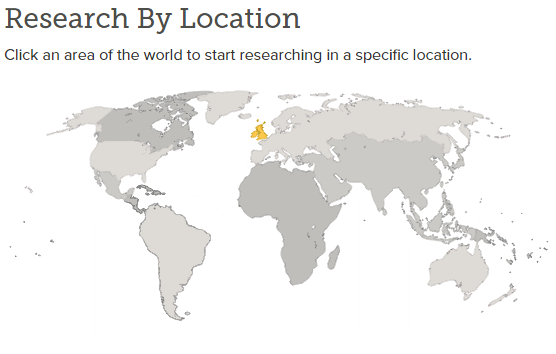
The
list of records is divided into two sections, transcribed records and untranscribed images. A camera icon indicates which of the
transcribed record sets have images associated with them, but this doesn't
necessarily mean you'll be able to view those images.
Tip:
an often overlooked feature of the new FamilySearch site is the 'wiki', which
provides information about individual parishes, often
including details of online sources of register transcriptions (follow this link to see an example).
Another
free site with a large collection of transcriptions is FreeREG - at the time of writing it
has 15 million baptisms, nearly 5 million marriages, and over 10.5 million
burials in its database. However, they're not evenly spread across the country:
some counties are very well catered for (Norfolk in particular), but others
less so - however it's fairly easy to see what is and isn't there. Other
volunteer-led projects include the Online Parish Clerk sites: they don't exist
for every county, but the counties with by far the best coverage are Cornwall, with over 2.2 million entries
last time I checked, and Lancashire with nearly 8 million records.
In
the late 19th and early 20th centuries the contents of some parish registers
were published as books, and your best chance of finding them is through sites
such as the Internet Archive, another free site,
where a search for (say) 'Kent parish registers' brings up a long list of
registers that have been printed in book form and digitised for all to see
(you'd pay to see some of these records as subscription sites!). Another
similar site is Google Books - inevitably there is
a big overlap between the two.
A
straightforward Google search is always worth trying, as quite a few
individuals have transcribed parish registers and posted the results on their
own websites, and some record offices have information that you can search free
online, for examples Hertfordshire has a range of
records including a marriage index, whilst Medway Archives have posted
registers for their part of Kent online (not transcribed, but at least they are
at your fingertips - and free).
Subscription
and pay-per-view sites
An
increasing number of parish registers and/or register entries are becoming
available online at Ancestry and Findmypast. When I first wrote on this topic
in February 2010 there were no register images available at either site, but
now you can search Warwickshire, Dorset, Lancashire, West Yorkshire, Liverpool, and most of London at Ancestry, and Cheshire, Devon, Hertfordshire, Manchester, Plymouth & West Devon, Shropshire, Staffordshire, Westminster, most of East Kent, large parts of Yorkshire, and much of Wales at Findmypast. Findmypast
also has unindexed register images for Lincolnshire.
Tip:
many cities and metropolitan boroughs have a record office which holds the
registers for their area, so that, for example, the Lancashire collection at
Ancestry doesn't include records for Manchester (you'll find these at
Findmypast), nor for Oldham or Rochdale. However Findmypast's
Cheshire collection does include Stockport, and also Warrington - which is now
in Cheshire, but was previously part of Lancashire.
Both
Findmypast and Ancestry have millions of other parish records in transcription
form, although quite a few of the records in Ancestry's collection have been
taken from books which you might be able to access free online. Durham Records Online has over 4 million
transcribed records from County Durham and Northumberland. The Joiner Marriage Index has over 2.5 million
marriage records from over 3700 parishes in 31 counties.
Essex Record Office offer online
access to most of their parish register collection - and whilst the
subscription is quite steep at £85 a year (the cheapest subscription is £5 for
one day), for many people with Essex ancestors it's the most practical
solution. I live in Essex, but it would cost me more to drive to Chelmsford and
back than to buy a 24 hour subscription, not least because of the cost of
parking when I get there. On the other hand, a visit to ERO would allow me to
access a wide range of other records which aren't available online.
Society
of Genealogists library
Many
of the largest collections of transcribed records held by the Society of
Genealogists are available online to members: these include Boyd's Marriage
Index, which has particularly good coverage in some of the counties (eg Suffolk and Essex) that are least well represented
in the IGI; for a PDF list of all the online collections click here. Over 9 million of the records are
also available through Findmypast.
The
Society of Genealogists has many more records in its library, including an
amazing collection of records on CD ROMs and microfiche collected by family
history societies and other organisations. Non-members can use the library on
payment of a fee, which ranges from £5 for 2 hours to £18 for a full day - more
details are available here.
Record
offices and archives
When
you're within striking distance of the relevant record office there's no
substitute for visiting in person - but check first what's available online so
that you don't waste your time there looking up records you could just as
easily (or perhaps, more easily) have searched from the comfort of your own
home. When I was beginning my research I wasted a lot of time searching parish
registers that had already been indexed for the IGI - I should, of course, have
focused on the unindexed parishes.
Many
record offices and archives will do research on a paid basis - a typical charge
is £30 per hour, which sounds a lot but in my experience is usually money well
spent. However independent researchers usually charge much less, and some record offices will provide as list
(especially if they don't offer a research service themselves). Please bear in
mind that the inclusion of a researcher on the list is not necessarily an endorsement
of that researcher.
The
importance of the Register of Banns
One
of the key reasons we search for the marriages of our ancestors is to find out
the maiden names of our female ancestors (of course, if they gave birth after
1837 you'll usually find this information on the birth certificate). If the
couple lived in different parishes, which was not unusual, they had to decide
which one to marry in - and typically it would be the bride's parish that was
chosen. This creates a slight problem, because we unless she survived until the
1851 Census we won't know where she was born (and even then, it wouldn't
necessarily be the parish where she was living at the time of her marriage).
Fortunately
the banns register often comes to our rescue. Most people married by banns,
rather than by licence, and if the couple lived in different parishes the banns
would necessarily be read out in both, and so would be recorded in the Banns
register for both parishes. However, there are not nearly as
many banns registers available online as marriage registers - you're more
likely to have to have to pay a visit to the record office.
Success?
When
we find the baptism or marriage that we've been searching for it's such a
relief that we often drop our guard, and forget to assess the information as
critically as we should. In the next article I'm going to talk about some
simple things you can do to dramatically increase the chances that the
information in your tree is correct.
How to be accurate - and why it matters!
You've
found someone with the right name, who was baptised or married at around the
right time in the right geographical area. So is it all right to add them to
your tree, or should you attempt to verify that you've found the right person -
and if so, how?
There
really is nothing worse in genealogy than identifying the wrong ancestor,
because every step you take from then on is likely to be wrong. If the person
whose baptism or marriage you were seeking has a common name then you should
definitely be on your guard - and in determining whether a name is common don't
judge it by the standards of today, but by those of the time and locality that
you're researching. Many surnames that have virtually disappeared today were
once common in certain localities, and forenames that even in former times were
relatively rare considering at the country as a whole, could be quite common in
some counties.
For
example, when you look at the country as a whole the forenames Roger and
Nicholas were fairly rare in the 18th century - but in Devon, where some of my
ancestors hail from, they were quite common.
Remember
that if you're relying on online resources you may only be searching a limited
subset of the parishes, especially if you're searching in the IGI, at FreeREG, or at an OPC site. You may only have found one or
two events that appear to fit the facts - but there could be many more that
haven't been transcribed and indexed. Just because you've only found one
baptism or one marriage that fits doesn't mean that you've found the only one
that fits.
Note:
researchers who don't live in Britain should acquaint themselves with the
geography of the area they're researching; the GENUKI site is a good place to
start. If you live in the US bear in mind that English counties are usually a
lot bigger than the US equivalent - more like a small state - so if you only
know the county where your ancestors came from there could be hundreds of
parishes to search.
What
other evidence might you gather to prove that the person you've found IS indeed
your ancestor? And even more important, how might you prove that he or she
ISN'T. The point I'm making is that we shouldn't simply be looking for
confirmation that we've got it right - we should search just as assiduously for
evidence that we've got it wrong. Sometimes the absence of evidence to the
contrary is the best proof available!
The
first thing I do is look for more events that seem to relate to the same
family, to try and build up a better picture. If you've found what you think is
your ancestor's baptism, look for other baptisms where the parents have the
same or similar names - remember that the further you go back the more common
spelling variations are, partly because there was many people were illiterate,
but also because for a long time spelling wasn't considered particularly
important.
Note:
even William Shakespeare couldn't make up his mind how to sign his name - and,
perhaps surprisingly, not one of the six surviving signatures in his own
hand have that first 'e'. See Wikipedia for more on this topic.
Sometimes
it will gradually become obvious that there were two families where the parents
had exactly the same names - or were so close that the vicar might easily have
confused them. Usually it will be fairly easy to separate them out based on the
timings and the choice of names - and often other information in the register
will help, such as the abode or occupation of the father. Even if only one
family had a child with the same name as your ancestor it's still important to
separate out the two families, because your next objective will be to find the
marriage of the parents - and you need some way of determining which couple it
is who married.
Simple
logic should be your guide. For example, it is extremely unlikely that there
would have been two surviving children with the same name in the same family;
and it would be quite unusual if one of the sons wasn't named for the father.
And if your ancestor was John Smith and his parents were William and Mary, it's
fairly likely that John wasn't their first son.
If
you can work out the years during which a couple were having children you're
half way to working out when they married and when they were born. I've often
seen researchers assume, having found the baptism of an ancestor, that his or
her parents were born about 25 years earlier, but unless you have reason to
believe that your ancestor was the eldest son or daughter it's quite possible
that the parents were much older, perhaps as old as 45.
The
names of marriage witnesses often provide helpful clues, but the burials
register is an even more important source of information. Many researchers have
convinced themselves that they've found the right baptism (and hence the right
parents) only to discover many years later that the child died in infancy.
Even
when you are fairly certain you've identified the right family, don't stop
researching other families in the local area with the same surname - after all
there's a reasonable chance that they are all related to each other.
Linking
up with other researchers who share the same ancestors is a great way to verify
that you're on the right track - provided that you haven't all gone down the
same wrong path. Some time ago I linked up with half a dozen cousins who,
though researching independently, had all made precisely the same mistake -
they believed their ancestor was telling the truth when he gave his father's
name on his wedding day.
But
that's an exceptional situation - the chances are it will never happen to you.
So my advice is to do everything you can to find your cousins, short of
publishing your family tree online. The safest and most accurate way to do this
is to complete your My Ancestors page - with just 97,000
members LostCousins certainly doesn't have the
largest membership of all the websites that aim to reunite you with your living
relatives, but we certainly have the most experienced membership (the average LostCousins member has been researching longer than I
have).
Using Family Tree Analyzer
to spot errors
The
Family Tree Analyzer program for Windows was
developed by a LostCousins member to perform all
sorts of tasks - indeed, if you set things up in the right way you can even get
it to tell you which relatives you've forgotten to add to your My Ancestors page!
But
it can also perform more basic checks on your tree - for example, Viv in
Australia wrote to tell me that FT Analyzer had
picked up a glaring error - one of her ancestors had been shown as dying before she married!
You
can download Family Tree Analyzer FREE by following
this link - it also has its own area in the LostCousins forum (you don't need to be a member of
the forum to read the discussions).
Checking your My
Ancestors entries
When
you enter relatives from the England & Wales censuses on your My Ancestors page you can click the  symbol to carry out a free census reference
search at the Findmypast site. This enables you to verify that you've entered
the census references correctly - it only takes 2 seconds - and that you
haven't made any errors or omissions.
symbol to carry out a free census reference
search at the Findmypast site. This enables you to verify that you've entered
the census references correctly - it only takes 2 seconds - and that you
haven't made any errors or omissions.
For
example, here's the entry from my page showing my great-grandparents and their
family in 1881 - try clicking one of the grey arrows:
Tip:
because the census references for the 1841 and 1881 census apply to an entire
page, with several households, and only the first 20 results are shown, you may
need to look at the next page of results.
You
can also use this feature to check your entries from the Ireland 1911 census,
in which case the search will use the National Archives of Ireland website. I
hope to offer searches for other censuses in due course, but at the moment it
isn't technically possible.
Tip:
when you're entering relatives from the 1880/81 censuses you should use the
transcription, even when it's wrong, but when you enter relatives from other
censuses it's what the handwritten census shows that matters. This information
is displayed on the Add Ancestor form along with other important advice.
Online will service still isn't working perfectly
There
are still problems with online ordering of England & Wales wills from 1858
onwards - as I reported a few months ago, the emails which tell you that the
wills you've ordered are ready for downloading don't seem to be co-ordinated
with the actual availability. In my case it meant that two of my wills were
ready for downloading long before the
email arrived, whereas the third wasn't available until some
time after I received the
email. In my case the delay was less than a day, but members have reported much
longer delays, especially over the Christmas period.
To
be fair, it is still described as a beta site - so some glitches are to be
expected. But in my opinion the contractors didn't test the system properly
before it went live. Let's hope the Probate Service haven't
paid the bill yet!
Frustrated with Findmypast?
Once
I figured out how to use the new Findmypast site I realised that it was a great
improvement on the old site - but I still get emails from members who are
struggling.
Here's
my secret: when I search at Findmypast I search a specific record set, by selecting
it from the 'A-Z of record sets' (ie the last option
in the 'Search Records' menu).
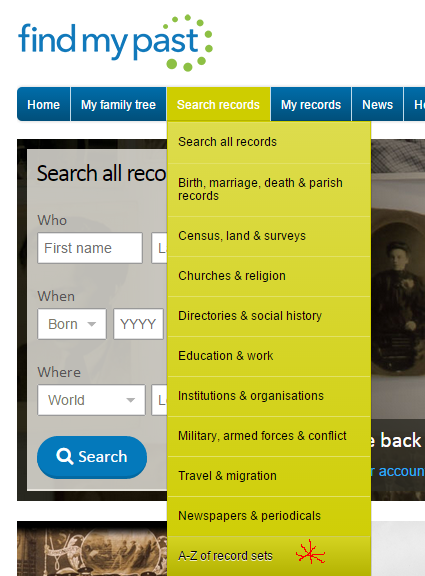
It's
so easy when you know how!
Reading between the lines
If
you're ever tempted to pay money to a family history website that hasn't been
recommended in this newsletter you might want to stop and ask yourself "If
this website is so good, why hasn't Peter mentioned it?".
Even
if a website is free you won't necessarily find me recommending it - if it
isn't obvious who runs a website, where it is based, and how it is financed I
get very suspicious (and so should you). You also won't find me recommending
"link farms", websites which simply link to other websites and have
little or no content of their own.
Warning:
it's very difficult for writers who have a daily genealogy blog to review every
site before they write about it, and as a result some simply republish press
releases they've received. This isn't a criticism of the bloggers themselves -
if I had to produce a daily newsletter I'd have the same problems as they do -
but it is something readers should bear in mind.
Rags to riches - how a laundry maid became a Viscountess!
Tony
sent me this wonderful true story about his great-great aunt Ellen - if you
came across it in a novel you might think it was ludicrously improbable:
"Ellen
Griffiths was a laundry maid, and the daughter of a gardener. To everyone's
surprise, she married a Viscount, the Right Hon. George Alan Broderick, fifth
Viscount Midleton and Baron Broderick of Midleton, County Cork, where he owned about 30,000 acres,
and second Baron Broderick of Peper Harow, his country estate in England. They were married on
14 May 1833 at St George Hanover Square, when she was just twenty one and he
was twenty six. George succeeded to the peerage in 1836, and assumed the tasks
of managing his vast estates and building and maintaining his homes.
"Several
busts of Ellen were commissioned by George, an indication of how much he felt
for her. Their marriage, however, began to suffer after a dozen years or so. As
a result, Ellen left her husband, and within a couple of years he committed
suicide on 1 Nov 1848 by inhaling fumes from burning charcoal. In the last
years, his mental state had deteriorated to the point that Ellen had written
several letters documenting his erratic and strange behaviour. All this came
out at the inquest where it was discovered that George had admitted privately
that it was all his own fault that his wife had left
him.
"The
Dowager Viscountess Midleton
received an ample income from the Midleton estate and
married Richard Quain F.R.C.S., F.R.S. on 25 April
1859. Quain,who was an
Irishman, became Surgeon Extraordinary to Queen Victoria. They had been happily
married for almost thirty years when Ellen died in 1886.
"Ellen
had bore no children in either marriage, but she had
adopted one of her nieces, Fanny Griffiths. Most of Ellen's immediate family
felt her benevolence through first class education or help with employment.
Fanny married a farmer, who mistreated her to the point that she left him. He
also eventually committed suicide, this time with dynamite! This can't be
genetic! She brought up her only child who eventually married in Brighton and
had a couple of children.
"When
growing up in Ilford, my father we used to have a full size white marble bust
of Ellen, but mother sold it when my father died. We would really like to find
it again, and to make contact with Fanny's descendants."
Mystery artist identified
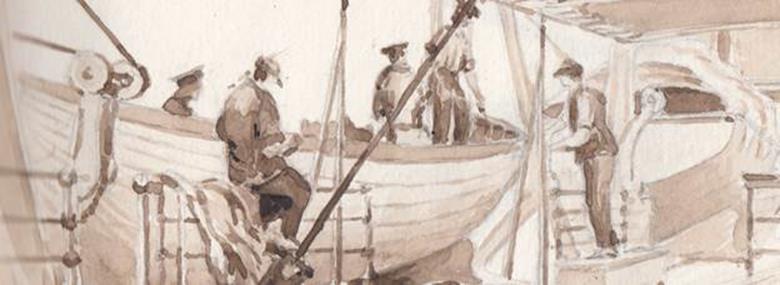
In
November I explained how
when LostCousins member John Makin and
his wife Alice discovered a sketchbook dating from the first half of the 20th
century thery decided to try to identify the artist.
The first sketches dated from 1925, and had been made on the voyage of
the Balmoral Castle to
South Africa in December of that year - so John and Alice started with a list
of the 225 passengers on that ship.
Now
the mystery has been solved! If you read their blog describing the search you can get a
feeling for just what it was like as they closed in on the anonymous artist.
Note:
so that they could share their voyage of discovery with other researchers they
published a little book featuring the sketches (you can get it through Amazon or direct from John's website).
Birthday Book puzzle solved?
The
quest that John and Alice embarked upon reminded me of the challenge I set readers of this
newsletter at Christmas 2012. I had come across a Birthday Book amongst a box
of books that I'd bought around 10 years previously at an auction of 'household
effects' in Great Dunmow, Essex - and the challenge
was to see whether we could identify the owner(s) of the book.
As an experiment I set up a wiki
where those of us taking part could post information and exchange ideas. If you
want to take a look you'll need a user name and password - the user name is 'lostcousins', and you'll find the password right at the
bottom of your My Summary page.
By
the spring of 2013 we had identified the last owner of the book as Christine M
Coleman, born in 1914, but we couldn't get any further - so I was amazed (and
delighted) this week when out of the blue I received an email from a new LostCousins member, Clare in Canada, who is her niece! I
hope that in the coming weeks and months we may be able to piece together more
of the story.
Review: A
Suitable Young Man
It's
not often that I review a work of fiction that isn't about genealogy, but I
enjoyed A Suitable Young Man so much that I
just had to tell you about it. The author of this extremely enjoyable book is
Anne L Harvey - who many of you will know from her articles in family history magazines
- and the story takes place in 1956, against the background of National Service
and the Suez Crisis.
I'm
not familiar with the area of Lancashire where it's set, and I was only 6 years
old at the time, but I'm glad to say that this didn't spoil my enjoyment in the
slightest - the people and locations seemed so real that I thought at first
that it must be semi-autobiographical. Judging from the effusive email I
received from a LostCousins member both the period
detail and the geography are spot on - this is what Val wrote:
"I
am only half way through but can tell now that it will be the best book I have
ever read. I can see Rivington Pike from my kitchen
window and my daily walks take me 'up Rivington' or
to Horwich.
"In
reading the book I am reliving my youth, everywhere the characters go I also
went, and the last train on a Saturday night out of Blackpool was spot on. It
used to be an exciting/frightening ride home where the lads did take the light
bulbs out and throw them out of the windows. Fortunately I was with my own
Teddy Boy boyfriend so felt safe enough. Like Kathy my
parents did not like my Teddy Boy but we rode out all
the rough seas and later married.
"We
had 55 years together but he sadly passed away last year, so this book is
evoking some extra special memories for me. I have to keep putting the book
down because I don't want it to end….."
I
didn't want the book to end either - so I was absolutely delighted to discover
that Anne has another novel in the pipeline. A Suitable Young Man is a skilful recreation of Britain in the
mid-1950s which reminded me what it was like to be young - and whilst some
people might pigeonhole the novel as romantic fiction, so was Pride & Prejudice. Mind you, there
is one big difference between Jane Austen and Anne L Harvey - Jane Austen
wasn't a LostCousins member!
Currently
only available in Kindle format, you can buy A Suitable Young Man from Amazon.co.uk, Amazon.com, Amazon.ca, and Amazon.com.au (note: if you use these
links LostCousins may benefit even if you end up
buying something completely different).
Genealogy in the
Sunshine - more places released
I
started the New Year in the best possible way - with a leisurely game of tennis
in the sunshine, followed by a swim in a lovely warm pool and a spot of
sunbathing!
You're
right - I wasn't in England, though I was in Europe and not the Tropics. For
the very first time my wife and I spent New Year away, at the Rocha Brava
resort on Portugal's Algarve coast where Genealogy
in the Sunshine will take place in March.
By
choosing our dates carefully we kept the cost of flights down to £100 each
(return), so it was a really cheap holiday in the sun - and I even got a
suntan. The timing was great - sunshine and blue skies every day - and we were
among the first to swim in the resort's new covered and heated pool, where the
water temperature hovered around 28 degrees.
In
March the weather should be even warmer - January is the coldest month on the
Algarve, with daytime temperatures comparable to England in May. But going over
for New Year was well worthwhile - because I managed to persuade the resort to
make available some additional apartments for the course in March. So if you
are interested, please take a look at the website I've set up - and get in
touch with me right away!
Stop Press
This
is where I'll post any last minute additions.
In
my next newsletter I'm going to provide some advice on knocking down 'brick
walls' - a perpetual problem for family historians like you and me!

Peter
Calver
Founder,
LostCousins
© Copyright 2015 Peter Calver
You
MAY link to this newsletter or email a link to your friends and relatives
without asking for permission in advance - but why not invite them to join
instead?
Amazon.co.uk Widgets