
1st October 2026 LostCousins Newsletter
Newsletter Edition – 1st October 2026
The LostCousins newsletter will be published once or twice a month while we are in transition. To access the previous issues and use the search feature, click here. To go to the main LostCousins website click the logo at the top of this newsletter. If you're not already a member, do join - it's FREE, and you'll get an email to alert you whenever there's a new edition of this newsletter available!
In this edition:
- LostCousins Upgrade News
- Ben Shaw: The Story of Bryan Blundell, Master Mariner, Philanthropist and Slave Trader
- NEW - Ancestry's release of 4 million slave records
- Birthday Books
- Explore the Royal School of Needlework's past
- Planning to Preserve your Research?
- Stop Press: TheGenealogist adds new Lincolnshire history AND is offering a lifetime discount!
LostCousins Upgrade News
Alexander and Tim have been very busy this month - and here is their news, which summarises a lot of planning as well as making things happen:
"In last month’s newsletter Siân explained why LostCousins is moving to modern systems and introduced the team doing the work. This month we’d like to show you what has been achieved since then, what is still to come, and what it will mean for you.
What we’re aiming for
● Keep what works. As Siân said, LostCousins isn’t becoming something different. You’ll still enter relatives from specific census households, and matching will stay as precise as it is today.
● Make it safer. Your data will sit on modern, well-protected servers and be backed up automatically every night.
● Make it easier to use on any device, whether that’s a desktop computer, a tablet or a phone.
● Build for the future. A modern foundation lets us add improvements far more easily than the old system allows.
Progress so far
● A new home. The new site is up and running on modern servers, where we are testing it thoroughly behind the scenes.
● Simpler signing in. You won’t need to remember another password. You’ll be able to sign in with your existing Google, Microsoft, Apple, Facebook or Yahoo account. If you use a different email provider, we’ll simply email you a one-time code to sign in with.
● The newsletter archive. Every newsletter back to 2004 is now in one place, including early issues that only ever went out by email. Members who joined more recently can read the full story of LostCousins from the beginning.
● Information pages. The About Us, FAQs, How It Works and census links pages have been rebuilt and updated.
● The forum. Forum members will already have seen last month’s upgrade to the latest version of the forum software. Next, the forum will move onto the same servers as the new website, which is simpler and more efficient to run. You should notice little difference: your posts and forum account come with it.
● Protecting your records. We have built tools that copy every member’s records from the old site to the new one. They have been tested many times on a copy of the existing data, so nothing will be lost.
What happens next
Next we’ll rebuild the member area, where you enter your ancestors and see your matches. When that has been thoroughly tested, we’ll copy everyone’s records across one final time and switch over. The address stays lostcousins.com. You won’t need to re-enter anything or join again, and we’ll give you plenty of notice before the change.
What you can expect
● A site that works on your phone or tablet as well as on your computer
● Faster pages and fewer frustrations
● No more forgotten passwords
● Stronger protection for the information you’ve entrusted to us
● New features added sooner than was possible before
We’re taking our time over this on purpose. LostCousins holds decades of careful research by tens of thousands of members, and getting it right matters more than getting it done quickly. Thank you for your patience and support. We look forward to showing you more in a future issue."
Ben Shaw: The Story of Bryan Blundell, Master Mariner, Philanthropist and Slave Trader
Ben Shaw is a writer and family historian whose research into his own family led him unexpectedly into the history of eighteenth-century Liverpool. He has recently joined LostCousins and brings with him a brand new book which might interest members with ancestral connections to Liverpool.
Ben's journey began in 2010, when he was given a mysterious 1595 Geneva Breeches Bible. He spent the next ten years trying to establish how it had come into his family, eventually discovering that the last person to write in it, in 1723, was almost certainly his 12th cousin, 11 times removed. That discovery led him to his 8x great-grandfather, Bryan Blundell. Although Blundell had never owned the Bible, his life and those of his descendants became an important part of the story of how it had passed through the generations.
His search for the bible’s origins also forced him to research many of the families in Liverpool between 1650 and 1850 and realising that many of them were interrelated in early Liverpool. It therefore opened up a much bigger story about Liverpool, its people and its history.
The research eventually became Ben’s first book, The Slave Trader: The Story of Bryan Blundell, a narrative non-fiction account of Blundell’s life at sea and his later involvement in the slave trade.
Blundell first went to sea aged 12, and Ben’s research led him to his surviving sea journal, held at Lancashire Archives. Using the journal alongside genealogical records, archival material and research into the places Blundell visited, Ben traces his life from his early years at sea to his later career as a Liverpool merchant, mariner and philanthropist. Blundell co-founded the Blue Coat School in 1709, but his life and business ventures also reflect Liverpool’s growing involvement in the transatlantic slave trade, which forms an important part of the book.
The story also uncovered another fascinating family connection: Christopher Bassnett, a nonconformist preacher who preached directly to Blundell and the crew of one of his ships, warning them of the moral dangers of entering the slave trade. Yet only a few years later, Blundell himself became directly involved in the trade. Ben is a descendant of both the preacher and the slave trader.
The book therefore offers more than the life of one man. It combines genealogy, archival research and historical investigation to explore eighteenth-century Liverpool, its merchant families, maritime connections and involvement in the transatlantic slave trade. For anyone researching Liverpool ancestors, particularly those whose family history reaches back into the eighteenth century, it may reveal familiar names, places and connections, while offering a glimpse into the world in which their ancestors lived.
What began with a search for the history of one family Bible ultimately opened the door to a much bigger history of Liverpool and the families who helped shape it.
We wish Ben every success with his book. You can order or reserve your own copy through one of the links below. Even better, LostCousins members have been offered 25% off the RRP when ordering through the UK publisher Pen & Sword - so don't delay!!
- UK Pen and Sword - Pen and Sword Books: The Slave Trader - Hardback (enter the code Trader25 at checkout for a discount of 25% off RRP)
- US – Barnes and Noble - The Slave Trader: The Story of Bryan Blundell, Master Mariner, Philanthropist and Slave Trader
- Australia - Booktopia - Slave Trader: the Story of Bryan Blundell, Master Mariner, Philanthropist and Slave Trader
NEW - Ancestry's release of 4 million slave records
Coincidentally, last week Ancestry released new digitised records of 4 million slaves on a freely accessible basis, and you can read all about it in this Ancestry Press Release which details exactly what you are likely to discover through them. I also thought that this extract was a poignant extension of the theme of Ben's book :
“Created by the British government following the 1807 abolition of the transatlantic slave trade to prevent illegal trading of enslaved persons, these registers were used to track and regulate the enslaved population in British colonies prior to emancipation,” said Dr. Matthew J. Smith, Director of the Centre for the Study of the Legacies of British Slavery at University College London. “While these administrative documents managed an unjust system, today they serve as primary sources that expose the human scale and administrative mechanisms of British colonial slavery and offer an entry point into understanding the lives of those enslaved.”
Birthday Books
It's sometimes strange how a perfectly ordinary event can turn extraordinary when conversations drift into discussing family history. Over a lunch out, a friend showed me some photos of a very old and fragile birthday book which she had inherited. While initially reticent to research any of her East London maternal ancestors because (putting it mildly) there was ample anecdotal evidence of things that she would prefer not to know about, she warmed to the idea once I offered to research some of the names in the book and possibly publish some of the findings.
Birthday books were small diary-style volumes used to record the birthdates of family and friends. They became a major cultural phenomenon in Victorian Britain during the late 19th century and were originally expensive, beautifully bound keepsakes that featured a specific quote, Bible verse or poem for every day of the year alongside a blank space for autographs. Popularised by publishers like Frederick Warne & Co. and George Routledge & Sons, they frequently compiled the works of famous British literary figures such as Shakespeare, Tennyson - and in this case, Longfellow- into best selling editions for mass publication. They were primarily cherished as social registries and sentimental keepsakes, passed down through generations to preserve a family's network of loved ones.
Here is my friend's birthday book- which she knew nothing about except that it was a family heirloom:
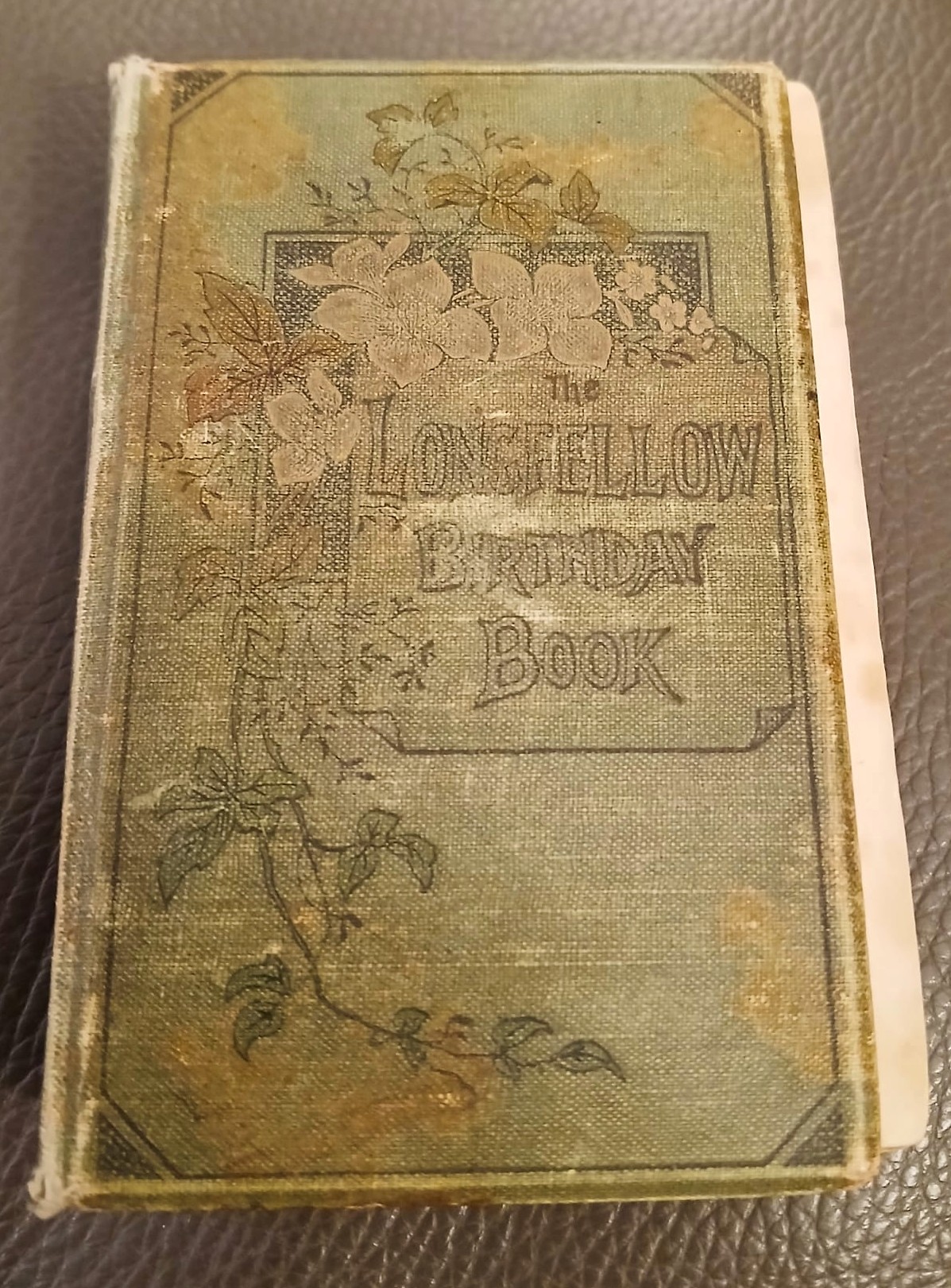
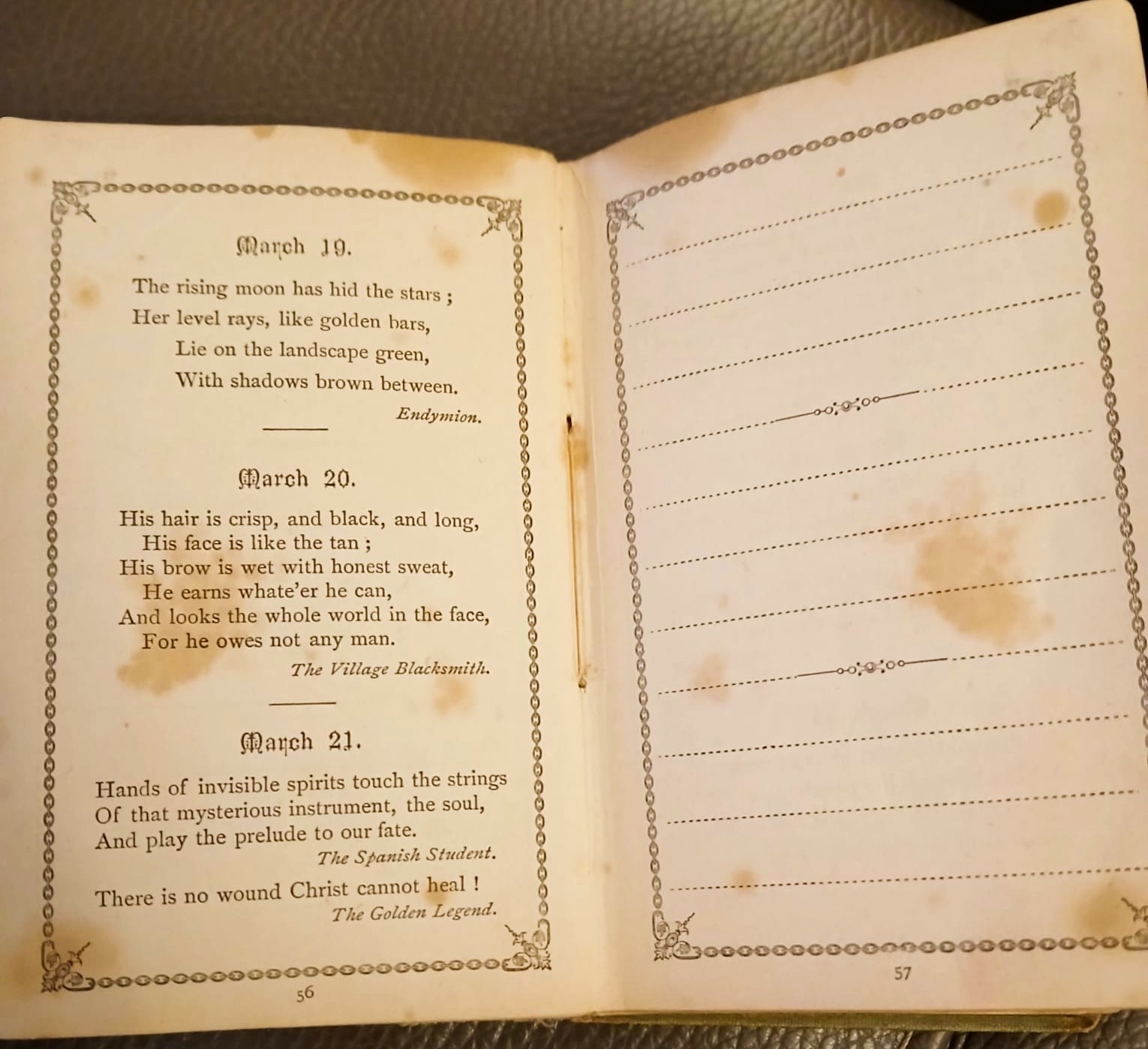
A Gemini AI analysis of these photos suggests that this book was a British mass market edition published between 1878 and 1885. Possibly this is one of the highly popular miniature versions of Charlotte Fiske Bates' arrangements of Longfellow's poetry which was first produced in the USA. The exposed twine supports the use of cheaper sewing with white string, as opposed to high end bookbinding. Green was the premier cover colour of the late 1870s and 1880s, and the floral design is typical of the Japanese-influenced simple, stylised nature motif that was also popular at that time. The printing of a black chain-linked frame on the blank pages would have avoided the cost of multi- coloured printing and was achieved by applying a single black-ink stamp. The three day layout was standardised in the 1880s, making these books very compact and portable. Because this version was printed in massive quantities, the value of a specific copy will be as a family heirloom and window into the lives of the ancestors whose names, birthdays and signatures are preserved in their own handwriting.
Once my friend has transcribed all of the information that she can glean from this example, it might be possible to compare the details against publicly held records, mindful that cherished keepsakes like this birthday book probably contain highly accurate information. The birthday book data could be used to verify exact dates, discover unrecorded relatives (such as children who were born and died between census dates), find maiden names and marriages, or help to reconstruct social circles and the timing of "joiners and leavers" within a close family network.
Further analysis of the book itself might reveal a publication date (a useful baseline for original ownership), authentic handwriting and signatures, including variations such as amendments to dates, crossed out entries (probably indicating a death), and the inks revealing clues about changes and amendments which might have been made a lot later on. Sometimes, addresses and notes were pencilled into the margins or at the back of the book.
There will be more revealed about this book as our collaboration unfolds. Meanwhile, here is a beautifully rich article from Cardiff University on how to get the most out of historical birthday books.
And who knows - one of your cousins might have a birthday book gathering house dust because they don't know what genealogical gold dust it contains. So it's worth asking other family members if they have ever seen a little book with poems on one page and autographs on the other!
Explore the Royal School of Needlework's past
Once upon a time, I almost accepted a job as a trainee working in the costume department at the Royal Opera House in Covent Garden, London. Had I not been lured by £500 more to work in a bank, I would have been considerably poorer but possibly happier developing my needlework skills to create some of the magnificent costumes worn by some of the most talented singers and dancers in the world. Findmypast have recently added a Royal School of Needlework Collection to their searchable database. While this is a comparatively small collection, it will be of interest to those whose ancestors worked or studied at the RSN. And for enthusiasts like me, these records bring life to an institution which has taught and produced fine needlework of the highest quality for royalty, the nobility and the performing arts. You can find out more about the history of the Royal College of Needlework to help put this new collection in context.
Planning to Preserve your Research?
I am gradually turning more of my attention to genealogy – and given that Peter had maintained family trees and DNA records for both of us with over 8,000 ancestors on Ancestry and Findmypast, my first steps have been to secure those accounts, which in hindsight I would have preferred to have done sooner. I discovered that the processes for “inheriting” Peter’s accounts are quite different and well worth outlining here, so that members might want to consider how to manage this issue while they still can. This means thinking not just about the death of an account holder, but illness or incapacity - such as failing eyesight, cognitive impairment or physical limitations.
Ancestry
Ancestry UK has a straightforward process for registering a Legacy Contact via Account Settings.
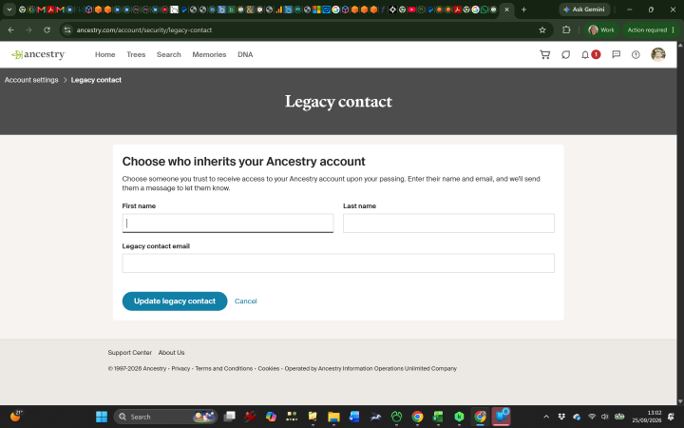
You should seek advance permission of the person that you choose and warn them to expect an email from Ancestry confirming that their details have been registered. Ancestry still needs to be informed about a member’s incapacity or death, and at that point the appointed Legacy Contact might want to check and update the payment details on the account so that renewal can still happen after the deceased member’s payment method no longer works. Maintaining the subscription preserves the account so that it can be managed after more urgent matters have been dealt with. After speaking with Ancestry, I decided to retain Peter’s account login credentials and update the contact details. I can now separate out my own family tree and DNA record while continuing to maintain Peter’s Ancestry account over the longer term.
Findmypast
Findmypast don’t offer an option to add a beneficiary to a member’s account. There is no information on their website about what to do if an account holder can no longer maintain their account, or what will happen to their data. I contacted them by phone (UK: +44 (0)20 3326 6300) to ask what could be done to maintain Peter's account. The most urgent change was to update the payment details for his subscription renewal, which was due in early October so this was crucial to preserving his records. They offered to change the email address registered to his account but again I decided to maintain the login credentials while updating the contact information. I asked Findmypast why they didn’t have a legacy/ beneficiary option or any FAQ/ guidelines about managing an account following a death, and they told me that they would look at this internally.
Takeaways
Family trees and DNA records uploaded to Ancestry and FMP are extremely valuable because of the potential for further matches, prompts and information coming from those organisations and other members. I was surprised at the higher number of ancestors within Peter’s online trees compared with the files he maintained on his laptop; clearly, he regarded the online trees as more important to keep regularly updated.
Here are my suggestions to improve the chances of preserving your research and online records:
- Don't just consider death as the only trigger for inheriting FH research. Incapacity/disability can strike a lot sooner.
- Discuss your family history research with your family or friends; remind them that they won't need to continue with the research immediately, but prompt action should be taken to secure both online and physical records.
- Introduce your beneficiary to where your main research is kept. This is by far the best opportunity to discuss the topic and test their interest and understanding.
- Provide your beneficiary with written instructions of how to access each of the accounts where your research is kept online, a reminder to change payment instructions to preserve the subscriptions, and a brief description of why the records on each site are important to maintain. Remember: not everyone will be experienced enough to understand what they need to focus on.
- Complete the Ancestry Legacy Contact page once you’ve identified a willing beneficiary.
- LostCousins also has a “my beneficiary” box on the “My Details” page where you can enter their email address.
- Consider other sites (like Findmypast) where you maintain an account containing valuable research; ask about their process for ensuring that an account can be inherited.
- Remember to update your beneficiary/ legacy contact if they predecease you or become too incapacitated to act on your behalf.
Stop Press: TheGenealogist adds new Lincolnshire history AND is offering a lifetime discount!
TheGenealogist has just released a new collection of Lincolnshire publications, providing family historians with access to parish register transcripts, marriage licences, local histories and detailed guides to the county and its communities. Spanning records from the 16th century through to the early 20th century, the newly available books contain a wealth of names, places and historical detail. They can help researchers trace baptisms, marriages and burials while also providing valuable background on the churches, streets, buildings, landowners and communities in which their ancestors lived.
Parish Records
Six important collections of registers, covering 47,000 names in records for Coleby, Alford and Rigsby, Bourne, Gainsborough, and St Margaret in the Close, Lincoln.
Along with Lincoln Marriage Licences 1598–1628, the Alford volume includes the baptism of Anne Hutchinson, daughter of the Rev. Francis Marbury of Alford, whose religious beliefs would make her one of the best-known figures in the early Massachusetts Bay Colony. Read her story here: Anne Hutchinson
Discover the communities behind the records
The new release goes beyond names and dates. Several of the books provide historical context that can help researchers understand the Lincolnshire their ancestors would have known.
Notices of the History and Antiquities of Spalding includes information on the town's landowners, houses, inns, buildings and local events. Its account of Spalding in 1619, for example, lists principal landowners and records the owners of houses and public houses in the parish.
Other books offer contemporary accounts of the county's churches, antiquities and Lincoln Cathedral. Contents range across towns and villages before examining the city of Lincoln itself, including the cathedral, castle, streets, schools, inns and notable Lincolnshire families. Together, these publications give researchers the opportunity not only to find Lincolnshire ancestors, but also to explore the places, institutions and communities that formed part of their lives.
The new records and historical books are available now to Diamond subscribers at TheGenealogist.co.uk.
Get Diamond for Less Than Standard - Only £119.95!
For a limited time, get a lifetime discount of £40 on a 12 Month Diamond Subscription, making it just £129.95 with a FREE 12-month subscription to Discover Your Ancestors Online Magazine (worth £36.00). Sign up here: TheGenealogist Offer
The newly released Lincolnshire publications include:
● The Registers of Coleby, Lincolnshire, 1561–1812
● The Parish Registers of Alford & Rigsby, 1538–1680
● The Parish Registers of Bourne, 1562–1650
● The Parish Registers of Gainsborough, Volume I, 1564–1640
● The Parish Registers of St Margaret in the Close, Lincoln, 1538–1837
● Lincoln Marriage Licences, 1598–1628
● Notices of the History and Antiquities of Spalding
● The Lincoln Pocket Guide (1880)
● Guide to Lincoln Castle (1924)
● J. Charles Cox's Lincolnshire
About TheGenealogist
TheGenealogist is one of the UK’s leading family history websites, offering extensive census, BMD, parish, military, occupational, wills, probate, land and property records. Its unique tools, including MapExplorer™, SmartSearch and advanced search features, help family historians discover not just who their ancestors were, but where they lived, worked and made their lives.
And finally…
Thank you for continuing to support and engage with LostCousins, especially while we make the website and forum more user friendly and exciting to use. We are looking forward to providing more newsletter updates as the project unfolds – so remember to check for our Latest Newsletter on the home page on or around 1st of each month!
Siân Lloyd
LostCousins
© Copyright 2026 Siân Lloyd
Please do NOT copy or republish any part of this newsletter without permission - which is only granted in the most exceptional circumstances. However, you MAY link to this newsletter or any article in it without asking for permission - though why not invite other family historians to join LostCousins instead, since standard membership (which includes the newsletter), is FREE?
Many of the links in this newsletter and elsewhere on the website are affiliate links – if you make a purchase after clicking a link you may be supporting LostCousins (though this depends on your choice of browser, the settings in your browser, and any browser extensions that are installed). Proud to be an Amazon Associate and an eBay Ambassador.