
4 March 2020 LostCousins Newsletter

Newsletter - 4th March 2020
Online genealogy - a safe haven in these troubled times
Victoria BDMs reduced for March
Save 25% on Ancestry DNA UK only
MASTERCLASS: How to make the most of your DNA test
Would you consider cloning your pet?
Secret door discovered at Westminster
Discovering family Bibles - at eBay!
Reading Early Handwriting: follow up
The LostCousins newsletter is usually published 2 or 3 times a month. To access the previous issue (dated 23rd February) click here; to find earlier articles use the customised Google search between this paragraph and the next (it searches ALL of the newsletters since February 2009, so you don't need to keep copies):
To go to the main LostCousins website click the logo at the top of this newsletter. If you're not already a member, do join - it's FREE, and you'll get an email to alert you whenever there's a new edition of this newsletter available!
There are extra prizes on offer for entrants in my New Year Competition - just log-in to your LostCousins account over the next week to see whether you've won a prize!
Tip: anyone who made an entry on their My Ancestors page during the period of the competition could be a winner - best of luck!
Online genealogy - a safe haven in these troubled times
Every day brings worrying news about the spread and impact of the new coronavirus, but there's one thing that comforts me - I'm definitely not going to catch a cold, let alone flu or the new coronavirus, as a result of researching my tree online.
Indeed, if you’re looking for a safe and productivity activity that will help to take your mind of what's happening (and what might happen in the future), online genealogy seems like a pretty good solution!
Note: don’t spend too long sitting down - make sure you get some exercise now and again, and if you're fortunate enough to have a breakfast bar (or some other piece of furniture that is taller than a desk), try standing up to use your computer for at least some of the time.
Victoria BDMs reduced for March
Uncertified images of birth, death, and marriage register entries for the Australia state of Victoria are discounted for the month of March, from $24.50 to $20.
You can find out more here.
Save 25% on Ancestry DNA UK only
If you’re a regular reader of this newsletter you'll know that when it comes to genealogical DNA tests, Ancestry are so far ahead of their competitors that you simply can’t ignore them. There may be circumstances in which it might make sense to take a second test with another provider, but if you’re only going to test once, it should be with Ancestry - no ifs, no buts.
So when there is a sale on, the only question is how many test kits to buy!
Why would you want to buy more than one test? For a start you might be researching on behalf of someone else - your spouse, perhaps. But the primary reason is to home in on the parts of your tree where you have your most annoying 'brick walls' - remember that DNA isn’t marked to indicate which ancestor each segment came from, so often the only way to identify which of your genetic cousins share which ancestors is to look at who else they match with.
For example, I arranged for my two surviving 1st cousins to test. They're both on my mother's side of my tree, so I can be pretty certain that any genetic cousins of mine that also match either Ruth or David are on that side of my tree. It's a lot of money to spend, of course, but I see it more as an investment - let's face it, a DNA test is as much a labour-saving device as a vacuum cleaner or washing machine!
Note: you don’t need an Ancestry subscription to contact your DNA matches or see the first 5 generations of their tree, but if you’re offered a discounted Ancestry subscription after buying your test (as many others have been), it’s well worth thinking about.
Please use the link below when you make your purchase so that LostCousins can benefit - and this newsletter can remain independent:
Ancestry.co.uk (UK only) REDUCED FROM £79 TO £59 (plus shipping) - ENDS 17TH MARCH
You may find that you need to log-out from Ancestry first, if so please click the link again before continuing.
Masterclass: How to make the most of your DNA test
Note: I've updated this Masterclass since it was published in August 2019
We can’t all be experts on DNA - I've written this Masterclass so that even if you don’t understand the first thing about DNA you can still get amazing results.
Here's all you really need to know about how DNA works:
- All of your DNA comes from your ancestors, but you only inherit half of your parents' DNA, they only inherited half of their parents' DNA, and so on
- DNA doesn’t skip a generation, so you can't inherit a segment of DNA from a grandparent unless your parent also inherited it
- Just because you and your cousins share ancestors doesn't mean that you'll share DNA - you could have inherited different bits of DNA from the ancestors you share
If you like you can skip the next section, which is a bit technical, and start reading again from The Reward
Introduction to autosomal DNA
If you’re male and you've previously tested your Y-DNA you might be expecting a set of numbers, For example, I tested 111 markers on my Y-DNA and I can see from my results how many repeats I have at each of those 111 sites - comparing my Y-DNA with that of other males who have tested is easy, and when I do the number of differences provides a rough guide to how closely related we are.
Autosomal DNA is very different - your DNA is sampled at around 650,000 to 700,000 sites across your chromosomes using a specially designed chip - a sort of miniature laboratory - and there are two readings for each site (because the autosomal chromosomes come in pairs). Although it sounds like a very large number, there are more than 3 billion base pairs in our entire genome, so the test is looking at fewer than one base in 4000. The bases are chosen because they are known to vary in the general population: however the majority don’t have have any known medical significance.
Looking at the raw data isn't going to tell you anything - it takes a clever computer program to compare your results with those of millions of others who have tested, identifying common segments of DNA. But even when those segments have been identified, there's nothing to say which ancestral line they came from - there are no names attached, nor any dates. Indeed there's nothing to say which half came from your mother or your father.
No matter how much experience you might have as a family historian, it would be understandable if, when the results of your DNA test came through, you were completely flummoxed about what to do next. There's a simple reason for this - we're used to working backwards from what we already know, so there's a clearly defined path, ie: find our ancestor's baptism in order to discover (or confirm) who their parents were, then find the parents' marriage, then find the baptisms of the parents and so on, working back a generation at a time.
The challenge
But when we're matched with a genetic cousin, someone who appears to have inherited an identical segment of DNA, we're faced with a very different challenge - we usually don’t know which of our ancestors we inherited that segment from, and the chances are the person we're matched with won't know either. It's rather like trying to do a complex jigsaw without first seeing the picture on the box.
Most of the matches we make with DNA cousins will be many generations back, since we have many more distant cousins than we do close cousins. The final column of the table below indicates roughly how many cousins you might expect to find if you and they all took the Ancestry DNA test:
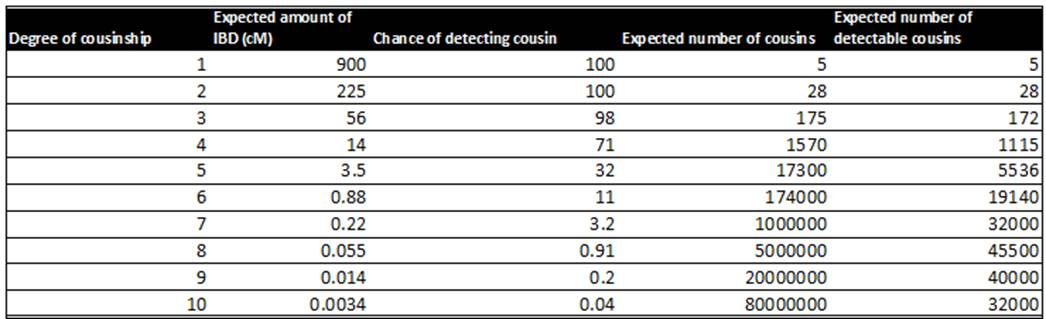
Based on Table 2 from: Henn BM, Hon L, Macpherson JM, Eriksson N, Saxonov S, Pe'er I, et al. (2012) Cryptic Distant Relatives Are Common in Both Isolated and Cosmopolitan Genetic Samples. PLoS ONE 7(4): e34267. doi:10.1371/journal.pone.0034267
Revised using Ancestry DNA estimates for the chances of detecting cousins and the expected number of 1st to 6th cousins for those of British ancestry; the numbers for 7th to 10th cousins are my own guesstimates
Of course, in practice only a small fraction of your cousins will have tested - even Ancestry, by far the biggest providers of autosomal tests, have only sold about 15 million tests - but you can nevertheless reckon that the cousins you're matched with will be distributed roughly in proportion to the figures shown above. In other words, over 99% of your matches will be with relatives who are at best 5th cousins, and could well be 8th cousins or even more distant. This won't necessarily be apparent when you look at your list of matches because there's a tendency for matches to appear closer or more distant than they really are.
Tip: Ancestry won't show any of your DNA matches as more distant than '5th to 8th cousin', but it's very likely that amongst them there are many who are more distant - possibly up to half of them. Once you get beyond 3rd cousins the length of the shared segment(s) is only a very rough guide to how closely you are related - you could share a 20cM segment with a 10th cousin, but no detectable DNA with a 3rd cousin. The same limitations apply at other sites too, of course.
This amazing chart from Blaine Bettinger's blog shows how variable the amounts can be, and how this affects the amount of DNA shared by more distant relatives:
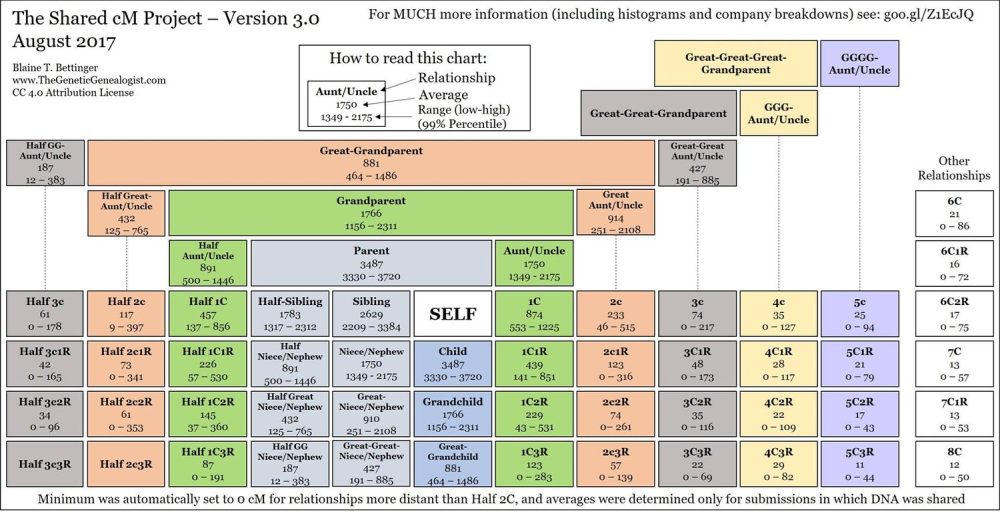
In each box there are three figures: the lowest and highest amounts shared between relatives of each order, together with the average. However the average only takes into account matches - if there was no detectable shared DNA it isn’t taken into account in the averages (but does show in the range).
What you will notice is that the average stabilises at around 12 or 13cM even for the most distant relationships in the chart. For example, you can see from the first table that the average DNA shared between 8th cousins is just 0.055cM, but the average in this chart is over 200 times greater. How can this happen? It's because unless there's a matching segment of at least 6 to 10cM most companies won't report a match at all - and because the chart only includes matches which were actually detected, it bumps up the average quite considerably.
Very interesting, you might think - but what does it actually mean in practice? What it tells us is that neither you, nor I, nor any of the DNA companies can reliably predict how closely we are related to our more distant cousins. So don’t rely on the testing company's estimate of how closely you’re related to a cousin, look at the chart and figure out what's possible, then consider what's likely (this means, for example, taking into account your age and that of your cousin).
Even if your DNA match is with a 5th cousin, someone who shares your great-great-great-great grandparents, it probably won’t be obvious how the two of you are related. I don't know about you, but I certainly can't say who all of my 4G grandparents were - indeed, I don't even know for sure who all my 3G grandparents were. I've got several 'brick walls' in the last 6 generations (though fewer than before I tested my DNA) - and most researchers, including my DNA cousins, are probably in the same situation. Go back another generation and there are even more gaps - and it just gets worse from then on.
In practice most of the ancestors that link us to our DNA cousins are on the other side of a 'brick wall' - and this could be a 'brick wall' in your own tree, in your cousin's tree, or both trees. What a fascinating challenge!
At this stage it's important to remind ourselves why we took a DNA test! If you're a regular reader of this newsletter it's very likely that the primary reason you tested was the same as mine - to knock down 'brick walls' that conventional research couldn't breach. If our 'brick walls' have resisted our efforts for years (or even decades), the opportunity to knock them down using DNA is well worth grasping, even though it will mean that we have to adopt a new and unfamiliar strategy, and utilise somewhat different techniques.
But unless you follow the advice in this Masterclass you’re likely to get in to a muddle. There are dozens of DNA bloggers and experts out there who promote techniques and apps that are wonderful in theory, but in practice are more likely to befuddle you and waste your time - in short, you could end up wishing you hadn't taken the test! Just because something is free and produces pretty pictures doesn’t make it useful.
Before you even get your results.....
Make sure that you've done all the conventional, records-based, research you possibly can. Remember, DNA testing isn't a substitute for records-based research - you need to do both to have a reasonable chance of success. Each builds on the other - if you only do one you're almost certainly going to fail.
Complete your My Ancestors page at the LostCousins site, ensuring that you have entered ALL of the cousins (no matter how distant) that you can find on the 1881 Census. Yes, it might take you an hour or two, but skipping this important step could cost you hundreds of hours in wasted time.
Tip: start in 1841 with all the relatives you can identify, whether or not you can find them on that census, then trace each of your branches (sometimes referred to as collateral lines) through to 1881. Remember, ALL of your living cousins are descended from the branches of your tree!
When you have completed your My Ancestors page click Search, then take a look at your My Cousins page to see which of your cousins have already tested. The next step is to contact them, and find out who they tested with. If they tested with a different company, ask if they have uploaded their results to GEDmatch, and if so, what their kit number is. Shared matches are the easiest way to figure out how you’re related to your DNA cousins, so knowing which of your documented cousins have already tested is crucially important.
How to process your DNA matches
I'm going to assume for the purpose of this article that you tested with Ancestry - but don't stop reading if you tested elsewhere because I'll be covering techniques you can use, though not as effectively, at other sites.
At Ancestry you'll typically have over 20000 matches with genetic cousins, and of those all but about 1% will be with 'distant' cousins, ie where the estimated relationship is 5th cousin or more distant. So you might think that the best strategy might be to focus on the 1% on the basis that if you can't make head or tail of those matches, your chance of resolving the more distant matches is negligible. Wrong, totally wrong - that approach will lead to frustration, disappointment, and disillusionment!
Here's how to get the best results and avoid all that wasted time and frustration:
Strategy 1: search by surname
My experience has shown that a much better approach is to search the trees of your matches by surname, in the hope of identifying cousins who have the same surname in their tree as one of your 'brick wall' ancestors. Here's how to go about it:
- First create a list of ALL your
ancestral surnames including any genuine variant spellings (ie ignoring mistranscriptions)
- How long ago did your DNA results
come through? If it's less than 3 days I would suggest waiting before
going any further - otherwise you might have to do everything twice (it
seems to take a few days for Ancestry to reconstruct their databases)
- Ready to go? Log-in to your
Ancestry account and click DNA to go to your DNA home page, and click the
green button labelled 'View All DNA Matches':

- On the next page you'll see a blue
link which reads 'Search'; click it

- Now you have the option of
searching by surname or birth location - or a combination of the two

Tip: unless the surname is a very common one indeed I don't enter a birth location - and even when I do enter a birthplace, I usually only enter the country; note that any birthplace you enter must be selected from the suggestions that Ancestry propose.
Enter the surname of one of your 'brick wall' ancestors and click SEARCH. This filters out the matches who haven't provided any family tree as well as those who have got a tree, but where nobody in the tree has the relevant surname.
You can’t use wildcards and I wouldn’t suggest checking the 'include similar surnames box' either (as in my experience the results are erratic). Instead carry out a separate search for each of the main variants.
Tip: this search will examine the trees that ALL of your matches have linked to their DNA results, whether they are public or private - that's what makes it such a powerful tool.
- The next step is to look at the
remaining matches - sometimes there won't be any at all, sometimes there
will be a handful. To examine a match click the user's name.
- If the other person has a public
tree then, even if your own tree is private, Ancestry will automatically
identify the surnames of direct ancestors which appear in both trees.
- Most of the time there won't be
an obvious connection between you and the other member, but that doesn't
mean that you should give up - there are still two more things you can try.
- first, click Shared Matches: much of the time there won't be any shared matches, since Ancestry ignore distant matches, but now and again you'll be lucky - and when you are, it's worth following up, even if the other person doesn't have an online tree
- second, look at the map to see which birth locations are shared
- If you're able to identify a
potential link send a message to your cousin telling them what you have
managed to figure out - they may have additional information that isn't on
their tree. You'll also need to contact your cousin if their tree is
private (or if you don’t have an Ancestry subscription, you'll need to ask
for permission to view their public tree)).
- If you're unable to figure out
how you and this particular cousin might be related, first make a note of
this fact (click the Add note link),
then move on to the next person in the list.
- When there are no more matches
with cousins who share this particular ancestral surname move on to the
next surname, remembering that whilst we tend to focus our attentions on a
small number of particularly frustrating 'brick walls', every ancestral line in our tree
terminates with a 'brick wall'.
- When you have worked through ALL of your 'brick wall' surnames it's time to move on to the next strategy…..
Strategy 2: search by birthplace
As you will have discovered when working through your list of surnames, most of the time the surname of the ancestors you share with a DNA cousin doesn't appear in both trees - indeed, it's quite possible that the surname of your common ancestor doesn't appear in either tree!
The problem is, when your female ancestors married they generally took their husband's surname. This makes it more difficult to research female ancestors whose children were born before the commencement of civil registration, since baptism registers don't usually give the mother's maiden surname - usually the only solution is to find the marriage. By contrast you can continue researching your male ancestors even if you can't find their marriage.
Of course, this problem doesn't simply affect you and your research - it affects your cousins too; most researchers' trees become increasingly sparse with each generation. If you've only identified 10% of your 256 6G grandparents and your cousins have only identified 10% of theirs, the odds of finding out how you're related to a 7th cousin simply by comparing the names in your trees are pretty remote (a little more than 1% in this example, not great odds).
Another way to figure out how you are related to your DNA cousins is to look for geographical overlaps - and here's how to go about it:
- Search for cousins whose
ancestors were born in the same villages, towns, or counties as your
ancestors - note that your search term must be selected from one of the
options that Ancestry display as you type
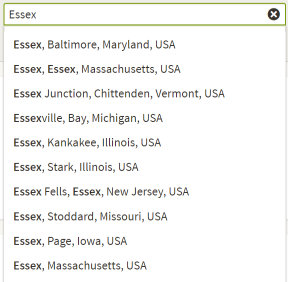
Ancestry's focus on the US means that Essex, England isn't shown until you type a little more, ie:
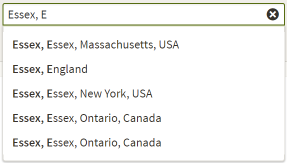
It's important to include the comma - simply typing 'Essex England' doesn't work.
Tip: abbreviations such as 'Gt' for 'Great' usually don't work (though there are some exceptions); also, entering the name of the parish church only works when it is part of the name of the village, eg Fornham St Martin
- When you find a DNA cousin who
has ancestors from the same area the next step is to evaluate how likely
it is that finding the connection could knock down one of your 'brick
walls. For example, if your cousin's most recent ancestors from that
location were born in the 1600s, but your most distant ancestors from the
same location weren't born until the 1800s, the chances of being able to
knock down your 'brick wall' are minimal, since there are many generations
separating you. On the other hand, if you both have 'brick walls' around
the same time, there's a chance that going back just one generation would
knock down both 'brick walls'.
- Once you've worked through all the places that your ancestors came from, it's once again time to move on to the next strategy……
Strategy
3: look for overlaps with the more unusual components of your ethnicity
Most readers of this newsletter have mostly British, Irish, or western European ancestry. But some of you will have Jewish ancestors, or ancestors from outside Europe, and whilst ethnicity estimates can be quite misleading, they do provide another way of analysing your matches.
Here's what Ancestry show for one of my DNA cousins:

If Ancestry had detected a Jewish component of my own ethnicity this would be one of the matches I'd be looking at very closely.
Strategy 4: look for the 'elephant in the room'
Because we all have 'brick walls' in our trees there are parts of our ancestry that are a closed book - yet there will inevitably be clues amongst our matches, if only we look for them. For example, if - like me - you don't know of any Irish ancestors, but have lots of matches with cousins who do, you might begin to wonder whether one of your 'brick walls' is concealing a connection to Ireland. I can't provide you with a step-by-step guide - it's all about awareness (Louis Pasteur said that "chance favours the prepared mind").
But beware of the common situation in which you share a single DNA segment with lots of people who all match each other. This suggests that the people you’re matched with come from an endogamous population, one in which people generally marry within the same community - in this case you would probably do well to ignore the matches altogether as any connection is likely to be a long way back.
More tips
.
- 'ThruLines' at Ancestry use other users' family trees to hypothesise connections to your DNA cousins - it's important to realise they do not use DNA to prove the connections. 'Common ancestors', also at Ancestry, attempts to identify the ancestors you share with your genetic cousins, even if they haven't researched back that far. Both of these features make use of private trees as well as public trees, so they’re not only saving you time, they're doing something that you might not be able to do yourself.
- You could search the trees of your matches for surnames which are not those of your ancestors, but appear in collateral lines - this may identify cousins who have not researched back as far as you have, so haven't encountered the surnames of the ancestors you share. Although this won't directly help you knock down your own trees you'll be helping your cousins - and it might benefit you indirectly (through shared matches).
- If your DNA test isn't proving as successful as you hoped you would be, it's likely to be because you've missed out a key step (for example, most of the people who contact me for advice have forgotten to complete their My Ancestors page).
Would you consider cloning your pet?
A couple in California were so devastated by the passing of their dog that they had him cloned using the same techniques that created Dolly the sheep. Some people consider it's unethical, and I suspect most people thinks it's unaffordable - and at $50,000 it’s certainly beyond my reach!
But why not read the story and make up your own mind?
Secret door discovered at Westminster
Historians working on the renovation of the House of Commons found a lost 360 year-old passageway, hidden in a secret chamber. It had been discovered before, in 1950 - during repairs to bomb damage - but it was sealed up and forgotten about.
See this BBC article for more information, including a photo.
Discovering family Bibles - at eBay!
In the last issue I mentioned that the prospect of discovering a family Bible was just one of the many reasons for us to connect with 'lost cousins' - and it prompted Kim to tell me about her experience:
"A few years ago, whilst touring the Hebrides, I picked up a message via Ancestry. A member collected family bibles, she had seen one on eBay for the Prescott family. She then searched on Ancestry and came up with my tree, it was actually the 4 x grandfather of my husband. I went onto eBay and the auction had ended, but the bible hadn’t sold. I contacted the seller who relisted it and I bought it for £13 plus £10 p&p Worth every penny. The families listed dated back to 1774. I will always be grateful to the lady who took the time to contact me."
I had a quick look on eBay while writing this article, and discovered numerous family Bibles for sale - could one of them belong to your family?
Reading Early Handwriting: follow up
In the last issue I published a review of Reading Early Handwriting 1500-1700 by Dr Mark Forrest - for a non-fiction work it created a great deal of interest, but that's not really surprising given that it's a problem that we're all faced with sooner or later.
This email from LostCousins member Bob underlines how important it is to be able to read documents ourselves, rather than rely on others:
I am pleased to see you drawing attention to the new book on Reading Early Handwriting 1500-1700 and I would like to see yet more encouragement for family historians to master this skill. So many of my genealogical contacts shy away from attempting to read even pre-1750 parish registers where the entries are largely predictable and they are cutting themselves off from so much, especially if, instead, they rely on transcriptions on Ancestry. Of course, the real treasure is in early wills and other documents and that seems to be a world that they absolutely refuse to enter.
An ability to decipher early handwriting opens up the possibility of genealogical skills complementing those of the conventional historian and making significant contributions in their discipline. I will give you two examples from my own experience.
1. Several
years ago I made contact with someone who had made corrections to gross errors
in Ancestry transcriptions for a Northamptonshire parish register in which I
had an interest. I thought they might be related to me. Although this proved
not to be the case, we exchanged information on other parishes in which we had
a shared interest and found that we were connected in a quite different way.
This led in turn to a contact with a third
party who had discovered that an ancestor we all shared had been involved in
the Newton Riot of 1607. 142 men and 2 women had subsequently received the
King’s pardon for their involvement in the Midland Uprising and the pardon
document with their names (some having actually signed) is preserved at
Northants Record Office.
I was able to transcribe this document in full and reveal that the only
previous attempt at a transcription, on which academic historians have all
relied, had only 75 of the names correct. One name had been omitted completely,
and two of those named were women, not just one as previously believed.
The main reason why I had so much greater success than the previous transcriber was that I had access to online images of the registers for the villages from which they came and could match surnames with those found in the register in spite of the terrible handwriting. In some cases I could identify the specific individual and trace his or her life story (also making use of their wills) to see how the events of 1607 impinged on the family.
Coincidentally I discovered a second ancestor among the 144 signatories, which seems astonishing. I wrote all this up for “Northamptonshire Past and Present”:
http://www.northamptonshirerecordsociety.org.uk/eNpp/NppNo71.pdf
Pages 17-35 are the relevant ones, but you may well find it rewarding to look through the rest of the journal. Bob's second example is much longer and has yet to be published, so I'm unable to reproduce it here, but I hope to be able to include a link in a future newsletter.
If you missed my review of Reading Early Handwriting you'll find it here.
This is where any major updates and corrections will be highlighted - if you think you've spotted an error first reload the newsletter (press Ctrl-F5) then check again before writing to me, in case someone else has beaten you to it......

Peter Calver
Founder, LostCousins
© Copyright 2020 Peter Calver
Please do NOT copy or republish any part of this newsletter without permission - which is only granted in the most exceptional circumstances. However, you MAY link to this newsletter or any article in it without asking for permission - though why not invite other family historians to join LostCousins instead, since standard membership (which includes the newsletter), is FREE?