
10 November 2017 LostCousins Update

Newsletter update - 10th November 2017
Ancestry.com offer HALF-PRICE subscriptions ONE DAY ONLY
Free access to military records at Ancestry.co.uk ENDS MONDAY
Latest DNA offers
MASTERCLASS: What to do with your autosomal DNA results
Downloading your DNA results - and uploading them to other sites
In the next full issue….
Stop Press
The LostCousins newsletter is usually published 2 or 3 times a month. To access the previous newsletter (dated 8th November) click here; to find earlier articles use the customised Google search below (it searches ALL of the newsletters since February 2009, so you don't need to keep copies):
Whenever possible links are included to the websites or articles mentioned in the newsletter (they are highlighted in blue or purple and underlined, so you can't miss them). If one of the links doesn't work this normally indicates that you're using adblocking software - you need to make the LostCousins site an exception (or else use a different browser, such as Chrome).
To go to the main LostCousins website click the logo at the top of this newsletter. If you're not already a member, do join - it's FREE, and you'll get an email to alert you whenever there's a new edition of this newsletter available!
Ancestry.com offer HALF-PRICE subscriptions ONE DAY ONLY
For just 24 hours, from 9pm Pacific time (5am next day London time) on Friday November 10th until 9pm Pacific time on Saturday November 11th, Ancestry.com are offering a 50% discount on all of their subscriptions (it doesn't, sadly, apply to current subscribers). This is an incredible offer - Ancestry are not renowned for their generosity, so if you've been biding your time waiting for an opportunity, this is it!
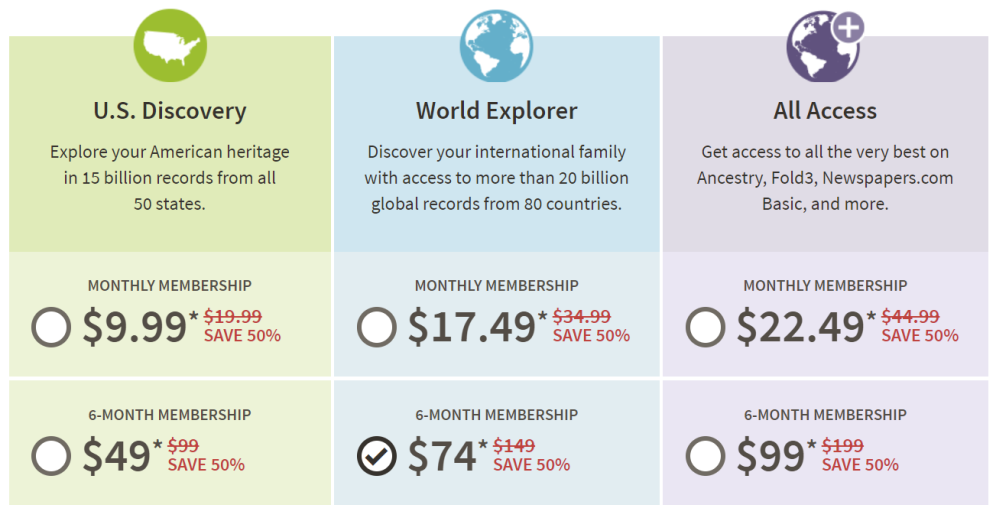
The discounted price only applies to the initial period, so clearly there's no point taking advantage of the offer unless you're going to buy a 6 month subscription. Your subscription will renew automatically at the standard price, not the discounted price - but you can cancel your subscription at almost any time during the first 6 months (you'll still get what you've paid for, of course). I say almost any time because if you cancel in the first 30 days they'll cancel your subscription and give you a refund, which clearly isn't what you want having secured such a very special discount!
A World Explorer subscription gives you access to all the records of Ancestry's worldwide records - indeed you can log-in to any of Ancestry's sites if, like me, you find it more convenient (the quick links on the home page vary from one country to another).
Note: the prices quoted do not include local taxes.
Click this link to take advantage of this incredible offer (and support LostCousins).

Free access to military records at Ancestry.co.uk ENDS MONDAY
Until Monday November 13 Ancestry.co.uk is offering free access to millions of UK military records - to search the records or see a list of all the included record sets follow this link. Note that you'll need to log-in (or register if you haven't done so previously) but you won't be required to provide credit card or bank details. Some of the indexes may link to images at the Fold3 website - my email from Ancestry didn't say that these are included in the offer - indeed, Fold3 isn't even included in Ancestry's World memberships, you need an All Access membership (as shown in the image above) - but one member has reported that her email read differently, though she did have to register separately at the Fold3 site.
Tip: you can also get free access to Findmypast's more extensive collection of military records, but only until Sunday - see this article from the last newsletter. The Findmypast offer includes US, Canadian, and Australian records as well as British records going back to 1760.
Latest DNA offers
Ancestry in the US have also announced a DNA Sale, with tests priced at $79 (down from $99) between Monday November 13 until Thursday November 23. But will they have an even cheaper price for Black Friday?
Other big news in the DNA world comes from 23andMe who are now offering ancestry-only tests in the UK, priced at £79 (previously UK customers could only buy a £149 test which included health-related information). And in the US 23andMe have an amazing offer when you buy 2 of their ancestry tests - they're just $49 each!
Please use the links below so that you can support LostCousins - in return I'll do my best to support you by continually updating them so that they take you to the best offers I can find:
Ancestry DNA (UK residents)
Ancestry DNA (US residents)
Ancestry DNA (Canada residents)
Ancestry DNA (Australia & New Zealand residents)
FamilyTreeDNA (worldwide)
23andMe (UK residents)
23andMe (US residents)
MASTERCLASS: What to do with your autosomal DNA results
I'm repeating this article from three months ago because when it was first published I was swamped by emails from members telling what amazing results they had achieved by following the simple strategies outlined - and over a million more people have tested in those 3 months.
Introduction
No matter how much experience you might have as a family historian, it would be understandable if, when the results of your DNA test came through, you were completely flummoxed about what to do next. There's a simple reason for this - we're used to working backwards from what we already know, so there's a clearly defined path, ie: find our ancestor's baptism in order to discover (or confirm) who their parents were, then find the parents' marriage, then find the baptisms of the parents and so on, working back a generation at a time.
The challenge
But when we're matched with a genetic cousin, someone who appears to have inherited an identical segment of DNA, we're faced with a very different challenge. Most of the matches we make with DNA cousins will be many generations, since we have many more distant cousins than we do close cousins. The final column of the table below indicates roughly how many cousins you might expect to find if you and they all took the Ancestry DNA test:
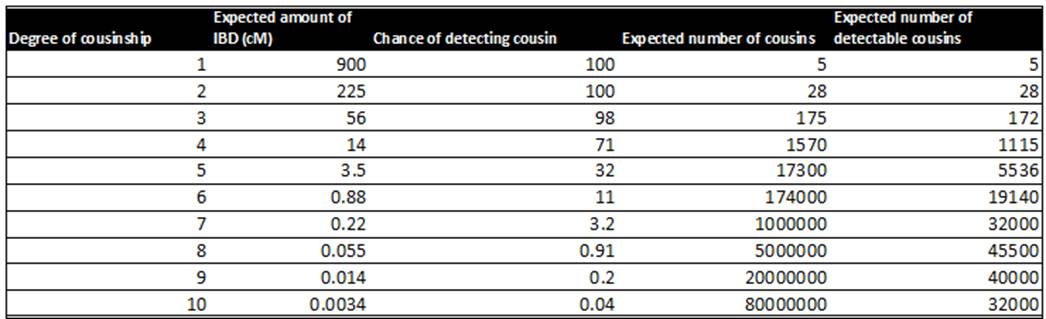
Based on Table 2 from: Henn BM, Hon L, Macpherson JM, Eriksson N, Saxonov S, Pe'er I, et al. (2012) Cryptic Distant Relatives Are Common in Both Isolated and Cosmopolitan Genetic Samples. PLoS ONE 7(4): e34267. doi:10.1371/journal.pone.0034267
Revised using Ancestry DNA estimates for the chances of detecting cousins and the expected number of 1st to 6th cousins for those of British ancestry; the numbers for 7th to 10th cousins are my own guesstimates
Of course, in practice only a small fraction of your cousins will have tested - even Ancestry, the biggest providers of autosomal tests, have only sold 6 million tests - but you can nevertheless reckon that the cousins you're matched with will be distributed roughly in proportion to the figures shown above. In other words, over 99% of your matches will be with relatives who are at best 5th cousins, and could well be 8th cousins or even more distant.
Tip: Ancestry won't show any of your DNA matches as more distant than '5th to 8th cousin', but it's very likely that amongst them there are many who are more distant - possibly as many as half of them. Once you get beyond 3rd cousins the length of the shared segment(s) is only a very rough guide to how closely you are related - you could share a 7cM segment with a 10th cousin, but no detectable DNA with a 5th cousin.
You and your 5th cousin share the same great-great-great-great grandparents. Now, I don't know about you, but I certainly can't say who all of my 4G grandparents were - indeed, I don't even know for sure who all my 3G grandparents were. I've got several 'brick walls' in the last 5 generations - and most researchers, including my DNA cousins, are probably in the same situation. Go back another generation and there are even more gaps - and it just gets worse from then on.
In other words, most of the ancestors who link us to our DNA cousins are on the other side of a 'brick wall' - and this could be a 'brick wall' in your own tree, in your cousin's tree, or even in both trees. What a challenge!
The reward
At this stage it's important to remind ourselves why we took a DNA test! Surely the primary reason we tested was to knock down 'brick walls' that conventional research couldn't breach? If our 'brick walls' have resisted our efforts for years (or even decades), the opportunity to knock them down using DNA is surely well worth grasping - even though it will mean that we have to adopt a new and unfamiliar strategy, and utilise somewhat different techniques?
How to process your DNA matches
I'm going to assume for the purpose of this article that you tested with Ancestry - but don't stop reading if you tested elsewhere because I'll be covering techniques you can use at Family Tree DNA and GEDmatch.
At Ancestry you'll typically have 5000 to 15000 matches with cousins, and of those all but about 1% will be with 'distant' cousins, ie where the estimated relationship is 5th cousin or more distant. So the obvious strategy is to focus on the 1% on the basis that if you can't make head or tail of those matches, your chance of resolving the more distant matches is negligible. However, that 'obvious' strategy would be wrong - and here's what you should do instead......
Strategy 1: search by surname
My experience has shown that a much better approach is to search the trees of your matches by surname, in the hope of identifying cousins who have the same surname in their tree as one of your 'brick wall' ancestors. Here's how to go about it:
- Starting from your DNA home page, click the green button

- At the top right of the next page you'll see a blue button; click
it

- Now you have the option of searching by surname or birth location
- or a combination of the two

Tip: if the surname is a rare one I don't enter the birth location - and even when I do enter a birthplace, I usually only enter the country. And don't expect the searches to work in the first 24-48 hours after you receive your DNA results - it takes Ancestry time to build the necessary indexes.
Enter the surname of one of your 'brick wall' ancestors and click SEARCH to filter out the matches who haven't provided a family tree as well as those who have, but where there nobody has the relevant surname.
Tip: this search will examine the trees of all of your matches, whether they are public or private - though if they don't have an Ancestry tree, or the tree they've uploaded hasn't been linked to their DNA test they're not going to show in the results
- The next step is to look at the remaining matches - sometimes
there won't be any at all, sometimes there will be a handful. To examine a
match click the green button at the right:

- Here's an example taken from my own tree - I've obscured
information that might identify my cousin:
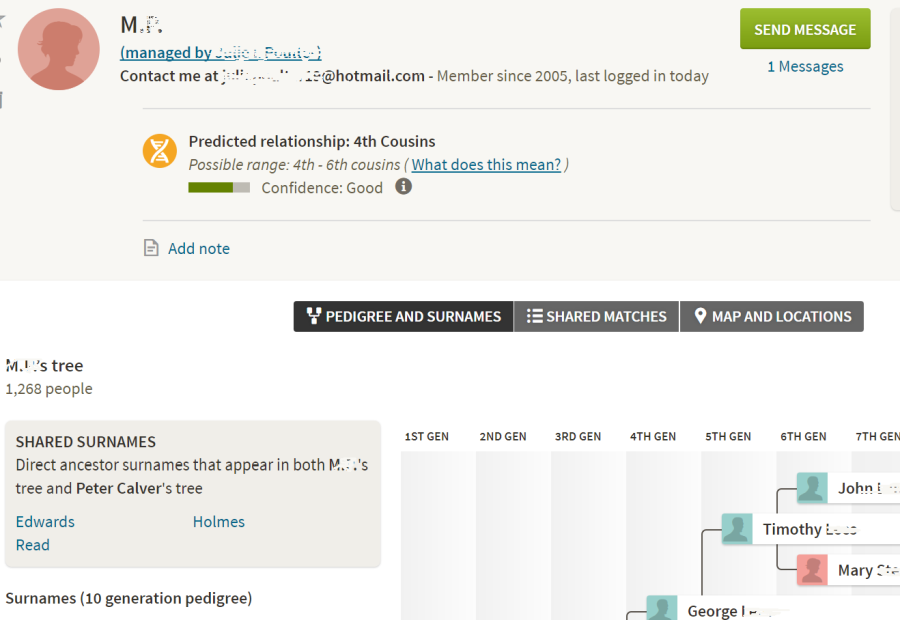
Ancestry automatically identify the surnames of direct ancestors which appear in both trees - but they won't tell you about other surnames which occur in both trees, even though these matches can be equally important, so it's well worth glancing through the complete list of your cousin's ancestral surnames.
- Most of the time there won't be an obvious connection between you
and the other member, but that doesn't mean that you should give up -
there are still two more things you can try.
- first, click the SHARED MATCHES button: much of the time there won't be any shared matches, since Ancestry ignore distant matches, but now and again you'll be lucky - and when you are, it's worth following up, even if the other person doesn't have an online tree
- second, click MAP AND LOCATIONS to see whether any of your cousin's ancestors come from the same places as some of your ancestors
- If you're able to identify a potential link send a message to your
cousin telling them what you have managed to figure out - they may have
additional information that isn't on their tree. You'll also need to
contact your cousin if their tree is private.
- But if you're unable to figure out how you and this particular cousin might be related, first make a note
of this fact (click the Add note
link), then move on to the next person in the list.
- When there are no more matches with cousins who share this particular ancestral surname move on to the next
surname, remembering that whilst we tend to focus our attentions on a
small number of particularly frustrating 'brick walls', every ancestral line in our tree
terminates with a 'brick wall'.
- When you have worked through ALL of your 'brick wall' surnames it's time to move on to the next strategy…..
Strategy 2: search by birthplace
As you will have discovered when working through your list of surnames, most of the time the surname of the ancestors you share with a DNA cousin doesn't appear in both trees - indeed, it's quite possible that the surname of your common ancestor doesn't appear in either tree!
The problem is, when your female ancestors married they generally took their husband's surname. This makes it more difficult to research female ancestors whose children were born before the commencement of civil registration, since baptism registers don't usually give the mother's maiden surname - usually the only solution is to find the marriage. (By contrast you can continue researching your male ancestors even if you can't their marriage.)
Of course, this problem doesn't simply affect you and your research - it affects your cousins too; most researchers' tree become increasingly sparse with each generation. If you've only identified 10% of your 256 6G grandparents and your cousins have only identified 10% of theirs, the odds of finding out how you're related to a 7th cousin simply by comparing the names in your trees are pretty remote.
Another way to figure out how you are related to your DNA cousins is to look for geographical overlaps - and here's how to go about it:
- Search for cousins whose ancestors were born in the same villages,
towns, or counties as your ancestors - note that your search term must be
selected from one of the options that Ancestry display as you type
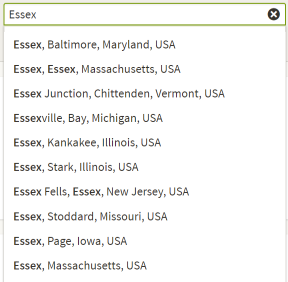
Ancestry's focus on the US means that Essex, England isn't shown until you type a little more, ie:
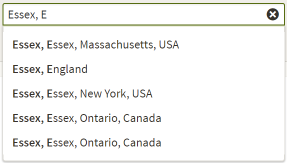
It's important to include the comma - simply typing 'Essex England' doesn't work.
Tip: abbreviations such as 'Gt' for 'Great' usually don't work (though there are some exceptions); also, entering the name of the parish church only works when it is part of the name of the village, eg Fornham St Martin
- When you find a DNA cousin who has ancestors from the same area the
next step is to evaluate how likely it is that finding the connection could
knock down one of your 'brick walls. For example, if your cousin's most
recent ancestors from that location were born in the 1600s, but your most
distant ancestors from the same location weren't born until the 1800s, the
chances of being able to knock down your 'brick wall' are minimal, since
there are many generations separating you. On the other hand, if you both
have 'brick walls' around the same time, there's a chance that going back
just one generation would knock down both 'brick walls'.
- Once you've worked through all the paces that your ancestors came from, it's once again time to move on to the next strategy……
Strategy 3: look for overlaps with the more unusual
components of your ethnicity
Most readers of this newsletter have mostly British, Irish, or western European ancestry. But some of you will have Jewish ancestors, or ancestors from outside Europe, and whilst ethnicity estimates can be quite misleading, they do provide another way of analysing your matches.
Here's what Ancestry show for one of my DNA cousins:

If Ancestry had detected a Jewish component in my own ethnicity this would be one of the matches I'd be looking at very closely.
Strategy 4: look for the 'elephant in the room'
Because we all have 'brick walls' in our trees there are parts of our ancestry that are a closed book - yet there will inevitably be clues amongst our matches, if only we look for them. For example, if - like me - you don't know of any Irish ancestors, but have lots of matches with cousins who do, you might begin to wonder whether one of your 'brick walls' is concealing a connection to Ireland.
I can't provide you with a step-by-step guide - it's all about awareness (Louis Pasteur said that "chance favours the prepared mind").
More tips
- When you look at your matches many of them will be shown as having no tree - but that doesn't necessarily mean that they don't have an Ancestry tree, simply that their tree hasn't been attached to their DNA results
Downloading your DNA results - and uploading them to other sites
Although more people have tested their autosomal DNA with Ancestry than all of the other companies added together, everyone can find more matches by uploading their results to the free GEDmatch site, and those who tested with Ancestry can also upload them to Family Tree DNA.
Downloading your results from one site and uploading them to another is a remarkably simple process - just so long as you know where to start. Ancestry users seem to have the most problems, though I can never figure out why - all you need to do is log-in, go to your DNA home page, then click SETTINGS at the top right. On the next page you'll see DOWNLOAD RAW DNA DATA at the right - click this button, then enter your password on the pop-up and tick the box below, and then click CONFIRM.
Within the next couple of minutes you'll receive an email with a link 'Confirm Data Download' - click this link and you'll be taken back to the Ancestry site. Finally click DOWNLOAD RAW DATA to download the Zip file. Where this file ends up depends on your browser settings, but mine can be found in the Downloads folder, so I'd suggest looking there first.
Tip: if your email from Ancestry doesn't arrive check your spam folder; the address it is sent from is AncestryDNA@ancestrydna.com so you could try adding that address to your address book.
Uploading your data to GEDmatch is very easy - simply log-in (or register if you haven't already done so) then click the Generic Upload link on their home page:
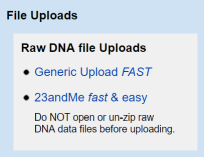
The only difficult part is waiting for them to process your data - it could take a day or two before you are able to search for matches. However if your initial aim is to look more closely at a match you've found at Ancestry, you don't have to wait - just so long as your DNA cousin has uploaded their results and told you their kit number (this is allocated by GEDmatch).
I'll be writing more about GEDmatch in future newsletters, but there's lots of guidance on the GEDmatch site, and you’re not going to break anything if you experiment. One word of warning: not all GEDmatch pages have a link to take you back to the home page, so you might need to use the browser back button (or else you could open GEDmatch in other tab).
Tip: GEDmatch are currently working on GEDmatch Genesis, which is in the beta testing stage (so you can try it out); currently GEDmatch Genesis offers the only way for those who tested at Living DNA to search for cousins, although will be offering cousin matching very soon.
In the next full issue….
I've rushed out this update to make sure that nobody misses out, But there are some great articles coming up in the next issue, including a case study featuring discrepancies between birthdates recorded in the baptism register and birthdates shown on birth certificates. I suspect that some of you will be surprised by the conclusions of the investigation!
Update 11.50pm (London time): the starting time of the Ancestry sale was originally notified as 9am but has just been corrected to 9pm (Pacific time) - Ancestry have apologised for any confusion.

Peter Calver
Founder, LostCousins
© Copyright 2017 Peter Calver
Please do NOT copy or republish any part of this newsletter without permission - which is only granted in the most exceptional circumstances. However, you MAY link to this newsletter or any article in it without asking for permission - though why not invite other family historians to join LostCousins instead, since standard membership (which includes the newsletter), is FREE?