
30 August 2016 NA LostCousins Newsletter

Newsletter - August 30, 2016
North American edition
Cut price subscriptions at Findmypast US BREAKING NEWS
Is this the cheapest DNA test? ENDS WEDNESDAY
You've got your DNA results - what next?
Looking for shared surnames
Why place names are more important than surnames
Do you have German ancestry?
Guest article: Recording for tomorrow
Anyone who had a heart…..
Old soldier was the last of his line
Preview: The Spyglass File EXCLUSIVE
6th Jefferson Tayte thriller is close to completion
Peter's Tips
Hot news!
The North American edition of the LostCousins newsletter is published occasionally. There's also a UK & Worldwide edition which is published 2 or 3 times a month - to switch to this edition change the preferences on your My Details page.
Whenever possible links are included to the websites or articles mentioned in the newsletter (they are highlighted in blue or purple and underlined, so you can't miss them). If one of the links doesn't work this normally indicates that you're using adblocking software - you need to make the LostCousins site an exception (or else use a different browser, such as Chrome).
To go to the main LostCousins website click the logo at the top of this newsletter. If you're not already a member, do join - it's FREE, and you'll get an email to alert you whenever there's a new edition of this newsletter available!
Cut price subscriptions at Findmypast US BREAKING NEWS
Findmypast have introduced a new low cost Starter subscription, which means that the price of their lowest-cost subscription is slashed from $114.50 to a mere $34.95 - which, according to my calculator, represents a reduction of almost 70%!
It's hard to believe that you can have 12 months (virtually) unlimited access to nearly 3 billion historical records and newspaper articles for such a trivial sum - in fact, I wouldn't have believed it either if I hadn't heard it from the horse's mouth.
What does Findmypast's Starter subscription include?
- US birth, marriage and death records (excludes premium marriage dataset)
- US immigration and travel records.
- US newspaper articles
- Britain/Ireland census records
You also get access to Findmypast's free records, which include:
- US census records
- Irish Parish Catholic Registers
- Exclusive land records and Irish Prison Registers dating from the 18th century
- Exclusive Irish Court records and Petty Sessions Order Books from 1842 to 1913
Not all North American records are included - for example, their new US Marriage collection is only accessible to researchers with a Premium subscription (which also includes the rest of Findmypast's worldwide collection - at a premium price). But you can always purchase credits to view records that aren't included in the Starter subscription.
Tip: even if this new subscription isn't right for you, I bet there's someone you know who would jump at the chance to get so much for so little. Talking of which....
Is this the cheapest DNA test? ENDS WEDNESDAY
Until midnight (CST) on Wednesday, August 31 you can buy a Family Finder test for just $69, possibly the lowest price ever for an autosomal DNA test.
Family Tree DNA have been providing DNA tests for genealogists like you and me longer than any of the other big names - and they've been leading the downward fall in prices. When I tested in 2012 the price was three times higher - and it will be higher again after Wednesday, when the sale ends and price goes back up to $99.
It's just as well that prices are falling because once you've got your own results you'll probably want to invite some of your cousins to test - and if you offer to pay for their test it's much more likely they're going to say 'Yes".
The advantage of cousins testing is two-fold: firstly, because the matches that you share become much easier to interpret, since you know that the 'new' cousin you've found must share at least one of the ancestral lines that you and your cousin share. The second reason is that some of the matches that you don't share with them will be with cousins that you do share (which is inevitable, because of the random way in which autosomal DNA is inherited) - this means that the pool of knowledge expands with every cousin who tests.
You've got your DNA results - what next?
The best thing about taking an autosomal DNA (atDNA) test is that you'll get hundreds, perhaps thousands, of matches with cousins - but how on earth do you figure out how you're related to all of them? I know from the emails I've had that for most researchers it's quite a conundrum, so I'm going to tell you what my strategy is....
But first, a reminder that anyone who takes an atDNA test thinking that it's easier than doing conventional research is likely to be sorely disappointed. Believe me, finding 'lost cousins' by completing your My Ancestors page is a LOT easier, as well as being infinitely cheaper. The time to turn to DNA is when you've gone as far as you reasonably can using paper records.
If you've just taken a DNA test and are waiting for the results you've probably got in mind some particular 'brick walls' that you'd like to knock down. At the last count I had about 70 'brick walls' in my family tree, but it tends to be the more recent ones - in the late 1700s or early 1800s - that are most frustrating, because they're the ones that have been outstanding the longest.
Let's suppose that, like me, you've got a great-great-grandmother who suddenly materialises in a big city on her wedding day. There are no confirmed sightings of her before that, and despite following every clue her birth and baptism simply can't be found.
I have 16 great-great-grandparents, so each of them is the gateway to 1/16th of my family tree. On average I've inherited 1/16th of my autosomal DNA from each of them, and - again on average - about 1/16th of all my DNA matches will be with cousins from that part of my tree. Since Family Tree DNA currently shows that I have 837 matches, that's around 50 for each of my great-great-grandparents.
Great - I've got 50 chances to knock down that annoying 'brick wall'! But wait a minute, how do I know which of those 837 matches are the ones I should be looking at? Indeed how can I know how any of my DNA cousins are actually related to me?
There's one obvious way to work out how you're related to your DNA cousins, and that's to look for familiar surnames in their tree. The first problem with this strategy is that not everyone uploads their tree, so you would have to email the other person; the second problem is that in most cases the surname of your common ancestor won't appear in both trees - indeed, it might not appear in either tree!
In conventional paper-based research we tend to spend more time working on males lines than female lines for one simple reason - males generally keep their surname when they marry, females usually don't. This makes it so much easier to research male lines, and as a result we don't discover a true cross-section of living cousins, or of deceased ancestors. However, unlike Y-DNA (which tracks the male line), autosomal DNA is passed on by both mother and father, which means that your DNA cousins are a much more representative sample of your living cousins.
The further back the common ancestor, the less likely it is that you'll recognise any of the surnames in your cousin's tree, or that they'll recognise any of the surnames in yours. Surnames will rarely tell you which ancestral line you share with a DNA cousin for the simple reason that most of your DNA matches are many generations back.
Why place names are more important than surnames
If the chances of finding surnames we recognise in the trees of our DNA cousins are small, what other options do we have?
People didn't tend to move around much before the 19th century - so geography is likely to be a much better guide than surnames (which, on average, changed every other generation). Even when people did move, they often didn't move far, at least until the Industrial Revolution took hold - so you're much likely to find that your DNA cousins have the same places in their tree than the same surnames. Usually it won't be precisely the same town or parish, but knowing that your cousin's ancestors and your own were (say) 20 miles apart in the 18th century strongly suggests where in your tree the common ancestor is likely to be found.
Of course, the common ancestor could be several generations back from your 'brick wall' ancestor, so even when you've found a geographical overlap you've still got research to do - but at least you've got a better idea where to look.
I have two German lines - but no real idea where in Germany they came from, which makes it very difficult to investigate any further. I recently wrote an article about the historic distribution of Irish surnames (you'll find it here) and I've recently discovered the Geogen site, which maps the distribution of surnames in modern Germany.
If you're struggling to find places in Germany there's a gazetteer that has recently been indexed and linked to historic maps - you'll find it here. At the moment there's no Help information on the website, so I've uploaded a PDF copy of the press release, which explains how to get the most out of the site - you'll find it here. (Thanks to Jenny from the Anglo German Family History Society - and a longstanding LostCousins member - for this tip.)
In 2014 I wrote about the Archion website which is making available online parish registers for the Evangelical Church of Germany - there are 13 partner archives covering a large part of the country, as you can see from the map here. It's a subscription site, but there are lots of different options - a 1 month pass costs just under 20 Euros (about $22 at the current exchange rate). The site is in English as well as German, though obviously the records are in German.
Tip: Trace Your German Roots Online by James M Beidler has had some excellent reviews - I haven't read this new book yet, but I did find his previous book on German genealogy very useful.
Guest article: Recording for tomorrow
This article was contributed by LostCousins member Peter King - I hope you enjoy it as much as I did.
My first tape recorder, reel to reel of course, I built from a kit in 1961.
To test it, I had my mother reciting poetry, father singing a song and my brother chatting. Mum & Dad liked doing amateur entertaining, proved by an entry in a local newspaper of 1923 (thanks to Findmypast). Those recordings I have until this day -and of course they're priceless. Christmas gatherings over a number of years were also recorded.
The day that I registered my father's death in 1967 was the day that my interest in Family History began; my mother had died 2 months before. Like so many of us, I had left it too late to ask them family history questions. Some years later, I recorded a chat with a WW1 comrade of my father's, who he met in France and was responsible for bringing him to Cornwall. That was an eye-opener!
My father was one of 7 siblings and as he moved from London to Cornwall, a lot of the relations came to Cornwall on holiday and that's how I met one of his sister's and many first cousins. I found more first cousins through my own research.
In the 70s and 80s my wife and I would go on holiday by car and visit or stay with relations, taking my big tape recorder with me and would chat to my first cousins and ask them about themselves and the family, helped by photos and other memorabilia. It became easier when the cassette recorder came on the market. Those earlier reel to reel recordings I gradually copied to cassettes and now from the cassettes I make CD's and send them to the next generation. A first cousin once removed in San Francisco, couldn't believe some of the things that her mother talked about with me. By the way, many of the relations came to stay with us.
You cannot separate family history from local history and so I recorded chats with family friends and colleagues who had left my birth area, as I had done. I even recorded a chat to one of my Dad's bosses. The last service in two of our local chapels and two researchers of my birth area from America visiting, I also recorded. An elderly family friend of many years, who used to live near where I was born, I drove around the area for two consecutive days and as we chatted in the car, I had a recorder going. His family love those recordings and I learnt a lot more local & family history.
On retirement, we travelled to Australia and a friend in Victoria had found me a new cousin just after we left home so I visited him and this time it was recording with a camcorder.
Over a period of about 40 years, I made nearly 100 recordings and spoke to first cousins & spouses from all my Dad's siblings and many relations on my Mother's side as well and indeed also my wife's family. I'm sitting on a huge Treasure Trove and often find out something new as I replay them. Most of the people that I've recorded are no longer with us. Material from the recordings has helped to turn my genealogy into family history.
Recording devices, even with video, are so small nowadays and inconspicuous that if you have the opportunity, go for it!
When Jeni Stepien walked down the aisle in Pittsburgh, PA earlier this month she was accompanied by the man who received her father's heart in 2006 after he died in a car crash! You can read more about this heart-warming story here.
But this wasn't the only donated organ in the news this month - a lady in England still has her mother's kidney, which is going strong even though it's now 100 years old! Sue Westhead was just 25 when she diagnosed with kidney disease in 1973, and her mother - then 57 - agreed to donate one of her own kidneys so that her daughter could live. I found this story on the BBC News website.
Also in the news was the bride who had a ghostly image of her recently-deceased brother added to her wedding photos - it's not something I'd personally recommend, but you can see the outcome and read more about the story here.
Coincidentally - or perhaps not - a joke about organ donation was voted the funniest of the Edinburgh Fringe Festival in Scotland. According to this BBC story Masai Graham won with the gag: "My dad suggested I register for a donor card, he's a man after my own heart."
But as a family historian I preferred the joke (relayed to me by a friend who attended the festival) about the failed illusionist who had two half-sisters…..
Old soldier was the last of his line
Stewart Cooney, a British soldier who served with the Royal Artillery in World War 2 was the last of his line - his wife and their adopted son had both pre-deceased him. So, when he died recently in a retirement home a quiet funeral was in prospect, with nobody in attendance other than staff from the home.
But, after an appeal on social media, hundreds of people turned out for the funeral - the chapel was overflowing with mourners paying tribute to a lonely old soldier who had served his country.
You can read more about this wonderful story here, on the BBC website.
Preview: The Spyglass File EXCLUSIVE
The new Morton Farrier genealogical mystery from Nathan Dylan Goodwin will be out on Thursday September 1st, but you can pre-order the Kindle version now if you follow this link to Amazon.com
But whilst it hasn't been published yet, I was privileged to be the first to receive a preview copy of the book - so I know that it's a real corker. In fact, the first page was so overwhelming that I had to stop for breath, and when I handed it to my wife to read she said it was the most powerful description of the Dunkirk evacuation that she'd ever read.
The Spyglass File is the 4th novel in the Morton Farrier series - and whilst you don't need to have read the first three books, why wouldn't you? You can see all of the books in the series, plus the novella that features LostCousins, if you follow this link.
Note: to support LostCousins when ordering this book (or any other) from Amazon Canada please use this link (the other links in this article will take you to Amazon.com).
6th Jefferson Tayte thriller is close to completion
Jefferson Tayte, the American genealogist imagined by Steve Robinson, the Anglo-American author who got me hooked on genealogical mysteries, will be back soon! Steve is close to completing the 6th book in the Jefferson Tayte series – so now’s the time to catch up if you’ve missed one of the earlier books.
You can find them all instantly (and support LostCousins) by following the appropriate link below:
Peter's Tips
I don't spend all my time doing genealogy: recently I've been busy in the kitchen!
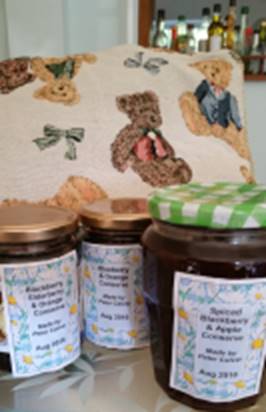 This month I've made pounds and pounds of jam,
including one old favourite (Blueberry & Orange), and three that are new to
me. The first new venture was a simple adaptation of the Blackberry &
Elderberry jam that I made for the first time last year - this time I added the
grated peel and juice of an orange, and I certainly feel it is an improvement.
This month I've made pounds and pounds of jam,
including one old favourite (Blueberry & Orange), and three that are new to
me. The first new venture was a simple adaptation of the Blackberry &
Elderberry jam that I made for the first time last year - this time I added the
grated peel and juice of an orange, and I certainly feel it is an improvement.
The next experiment was an adaptation of a recipe for Spiced Blackberry & Apple jam which I found here - I added some sultanas, and upped the cinnamon, in order to give it a more Christmassy flavour. Finally, after potting most of that batch I added a couple of thinly sliced chillies to the remaining mixture and heated it up again. The end product was very tasty, if somewhat milder than I expected - which was possibly a good thing!
Of course, I've not just been making jam - stewed Blackberry & Apple is delicious for breakfast with a spoonful or two of low fat natural yoghourt. And as the wild Shepherd's Bullaces are starting to ripen much of my spare time is going to be spent foraging and cooking for weeks to come!
Do you have a favourite recipe that you'd like to share with an enthusiastic amateur cook on the other side of the pond? I'd love to hear about it!
Finally, back to genealogy. Can I point out a new section on your My Details page at the LostCousins site where you can tell me whether or not you've taken an autosomal DNA test (such as the Family Finder test mentioned above)? In due course this information will also be made available to the cousins you're matched with, making it easier to devise and co-ordinate an efficient and cost-effective testing strategy.
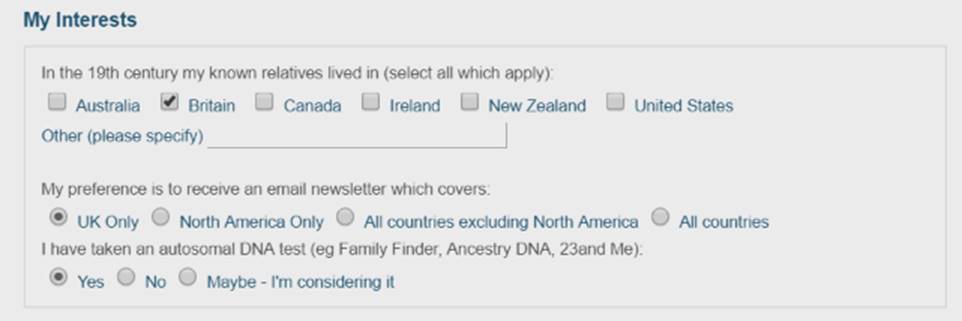
Note: if you are currently only receiving my North American newsletters, but would like to receive the main newsletter (which is published 2 or 3 times a month) simply change your preferences by choosing any of the other options shown in the graphic above.
Hot news!
This is where any last minute updates and corrections will be highlighted - if you think you've spotted an error (sadly I'm not infallible), reload the newsletter then check here before writing to me, in case someone else has beaten you to it......
That's all for this issue - I'll be back soon with more news from the wonderful world of genealogy.

Peter Calver
Founder, LostCousins
© Copyright 2016 Peter Calver
Please do not copy any part of this newsletter without permission. However, you MAY link to this newsletter or email a link to your friends and relatives without asking for permission in advance - though why not invite them to join LostCousins instead as standard membership, which includes this newsletter, is FREE?